Budapest vs Riga: Which City Should You Choose for Your Erasmus?
Budapest or Riga for your Erasmus? We compare both cities on cost, housing, social life, universities and weather so you can pick the right one.
Both cities show up on almost every list of the best value Erasmus destinations in Europe. Both are EU capitals with strong international student scenes. Both are affordable in a way that most Western European cities genuinely aren't anymore. And Fuse Stays operates in both.
So if you're trying to decide between them, this is the guide that works through the actual differences, not just the ones that look good on a ranking list.
The Short Version
Choose Budapest if you want a bigger city, a more established international student scene, more nightlife, and easier connections to the rest of Europe.
Choose Riga if you want a more intimate city feel, lower costs overall, and you're drawn to something a bit less obvious, a genuine European capital that most people haven't fully discovered yet.
Now the detail.
Cost of Living: How Far Your Money Goes
Both cities are affordable. Riga has a slight edge.
Budapest total monthly budget: Most students land between €750 and €950 per month covering rent, food, transport and a social life. The famous €9 monthly student transit pass is one of the best transport deals anywhere in Europe, which helps significantly.
Riga total monthly budget: Slightly lower across most categories, with most students spending €700 to €900 per month. Groceries, eating out and entertainment are all marginally cheaper than Budapest, though the gap isn't dramatic.
Where the difference matters most is in winter heating. Both cities get cold, but Riga winters are harsher, regularly hitting minus ten to minus fifteen in January and February. If your rent doesn't include heating, you'll feel it in your utility bill. In Budapest, winters are cold but slightly milder, and the heating spike is less severe.
The smartest move in either city is all-inclusive accommodation, specifically because it removes that variable entirely. Fuse Stays operates in both Budapest and Riga with fixed-price contracts covering rent, utilities and WiFi, so your monthly number stays consistent whether it's September or February.
See Budapest rooms | See Riga rooms
Housing Market: What You're Actually Choosing Between
Budapest has a larger and more competitive private rental market, with more listings in English and more operators who are experienced with international students. The districts closest to universities and nightlife (VII, VIII, IX) fill up fast for September starts, so booking early matters.
Riga has a tighter rental market that relies heavily on local contacts and Latvian-language platforms. International students booking from abroad are at a real disadvantage in the private market here, which is one of the reasons that going through a managed operator makes more practical sense in Riga than in Budapest.
In both cities, Fuse Stays offers all-inclusive co-living on fixed-term contracts of 5, 6, 10 or 12 months, with a remote booking process that doesn't require in-person viewings or local references. It's genuinely useful in both cities, but especially in Riga where the alternative (navigating a Latvian-language rental market from abroad) is more difficult.
Universities: Who Studies Where
Budapest draws the most diverse international student population of the two, with multiple well-known universities each attracting significant numbers:
- Corvinus University for business, economics and social sciences
- Budapest University of Technology and Economics (BME) for engineering and technical programmes
- ELTE (Eötvös Loránd University) for humanities, sciences and law
- Semmelweis University for medicine, one of the leading medical schools in Central Europe
Riga's international student intake is more concentrated:
- RSU (Riga Stradinš University) is the biggest draw, particularly for medical and health sciences students from outside the EU. RSU is one of the most internationally diverse campuses in the Baltic states
- RTU (Riga Technical University) for engineering and technology
- University of Latvia for a broader range of programmes
If your specific programme is at RSU or RTU, Riga is your city. If you have a choice between institutions in both cities, the academic profile of each university matters more than city preference.
Social Life and Nightlife: Honest Comparison
Budapest has one of the most distinctive student social scenes in Europe. The ruin pub culture (bars set up inside the shells of abandoned buildings in District VII) is genuinely unlike anywhere else. There are thermal baths you can actually afford to visit regularly, a growing number of cultural venues, and a size that means there's always something happening somewhere.
The international student community in Budapest is large enough that you'll have a ready-made social network almost immediately, which makes it easier to meet people early in the semester. ESN Budapest is one of the more active chapters in Central Europe.
Riga has a smaller but genuine social scene. The Old Town is exceptionally beautiful and walkable, the nightlife is concentrated but good, and the beach at Jūrmala is less than half an hour by train and costs almost nothing to reach in summer. There are rooftop bars, good restaurants and a café culture that's improved significantly over the last few years.
The honest trade-off is scale. Budapest simply has more going on, more variety, more volume. Riga offers a tighter, more intimate version of student life where you're more likely to end up knowing the same crowd of internationals by week three. For some students that's exactly what they want.
Getting Around
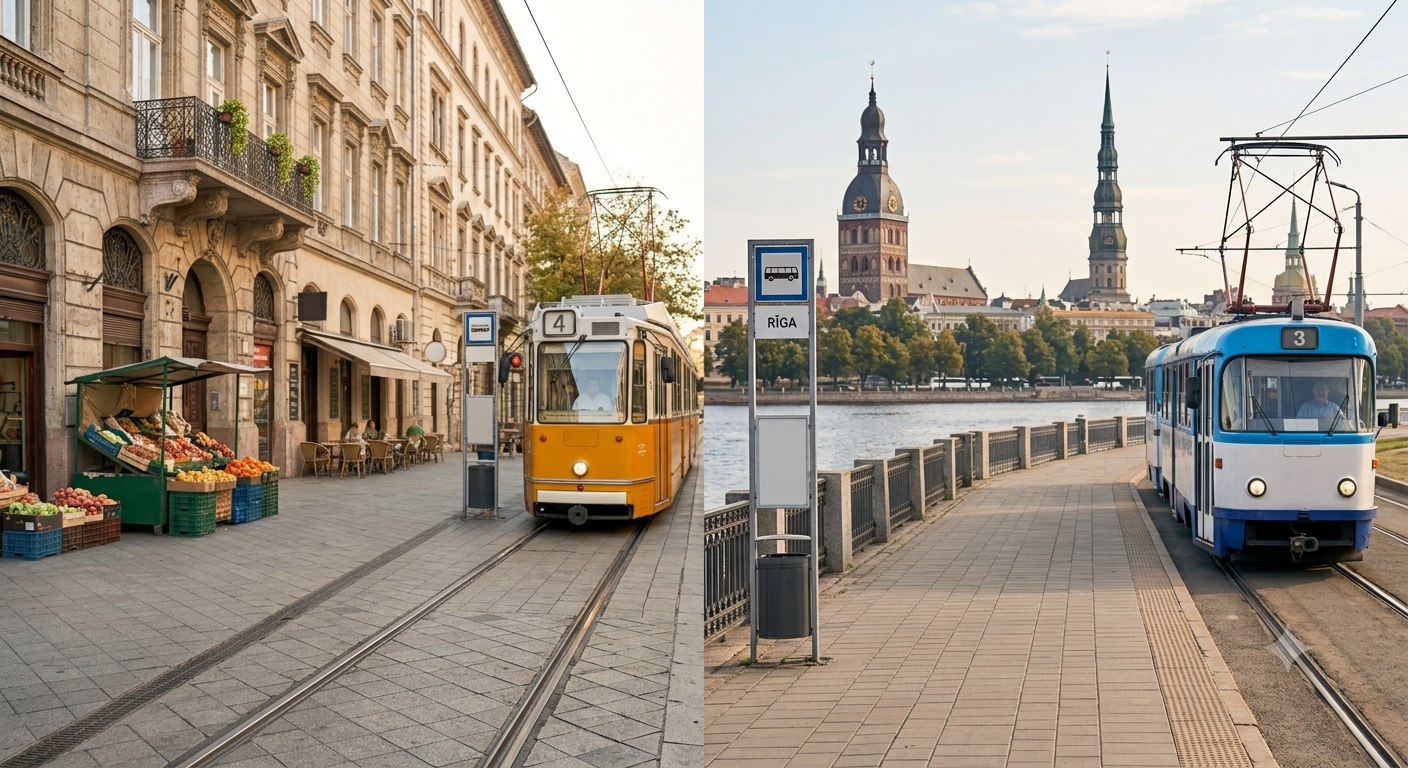
Budapest has a metro (three lines), extensive tram network, buses and night buses, all on the same monthly student pass at around €9 per month. The 4/6 tram running along the Grand Boulevard 24 hours a day is genuinely excellent and covers most of what students need.
Riga has trams, buses and trolleybuses, no metro. The monthly transit pass runs around €30, with student discounts available through your university. The city is smaller and more walkable than Budapest, which partially compensates for the simpler transit network. Very cyclable in spring and summer.
Both cities are easily navigable without a car, which is the relevant test for a student.
English Friendliness
Both cities are fine. English is widely spoken in student environments, at universities, and in bars, restaurants and shops in central areas. Neither city requires you to speak the local language to function as a student.
Hungarian (spoken in Budapest) and Latvian (spoken in Riga) are both languages with almost no utility outside the country. Learning basic phrases is always appreciated and will get you a warmer reception in local spots, but it's not a practical requirement for either city.
Weather: Being Honest About Winter
Both cities have four distinct seasons with real winters. If you're coming from a warm climate this matters.
Budapest winters: Cold, with occasional snow. Temperatures typically sit between minus five and plus five Celsius from December to February, with some colder days. Spring arrives properly by April. Hot summers.
Riga winters: Colder and longer. Minus ten to minus fifteen Celsius in January and February is normal. Snow is reliable rather than occasional. Spring comes later. If you're doing a semester from September to January, you'll experience the tail end of Riga's real winter toward the end of your stay.
Neither is extreme by Central European standards, but Riga wins the competition for "which city will make you buy a better coat."
The Bottom Line
Budapest | Riga
Monthly budget €750 to €950 | €700 to €900
City size Large (1.7m) | Mid-size (600k)
Social scene Extensive | Intimate
University variety High | Concentrated
Private rental market Easier to navigate | Tighter, more local
Winter severity. Cold | Quite cold
Transit cost. ~€9/month | ~€30/month
English friendliness. High | High
Pick Budapest if you want a bigger city with more going on and a more established Erasmus scene. Pick Riga if you want something slightly different, lower costs, and a smaller city where you'll build a tighter social circle.
Fuse Stays has rooms in both. If you're genuinely undecided, the most practical move is to check availability in both cities at the same time and let the room options help you decide.
Frequently Asked Questions
Is Budapest or Riga cheaper for students?
Riga has a slight edge on overall monthly costs, with most students spending €700 to €900 per month versus €750 to €950 in Budapest. The difference narrows significantly once you account for Riga's winter heating costs if utilities aren't included in your rent.
Which city is better for Erasmus social life?
Budapest has a larger, more established international student scene with more variety in nightlife and activities. Riga is smaller and more intimate, which suits students who prefer a tighter social circle over a large scene.
Is English enough to live in Budapest or Riga?
Yes in both cities. English is widely spoken in student environments, at universities, in bars, restaurants and most city-centre situations. Neither city requires the local language to function as a student.
Does Fuse Stays operate in both Budapest and Riga?
Yes. Fuse has all-inclusive co-living in both cities on fixed-term contracts of 5, 6, 10 or 12 months. You can browse and compare rooms in both cities at fusestays.com.
Which city has better transport for students?
Budapest has a more extensive transit network including a metro, at a lower monthly student pass price (around €9). Riga's network is simpler but the city is smaller and more walkable, which partially offsets the difference.