Coliving vs Dorm in Budapest: Which Actually Makes Sense?
Dorm or coliving in Budapest? Here's how cost, privacy, flexibility and community actually compare, so you can pick the right one for your semester.
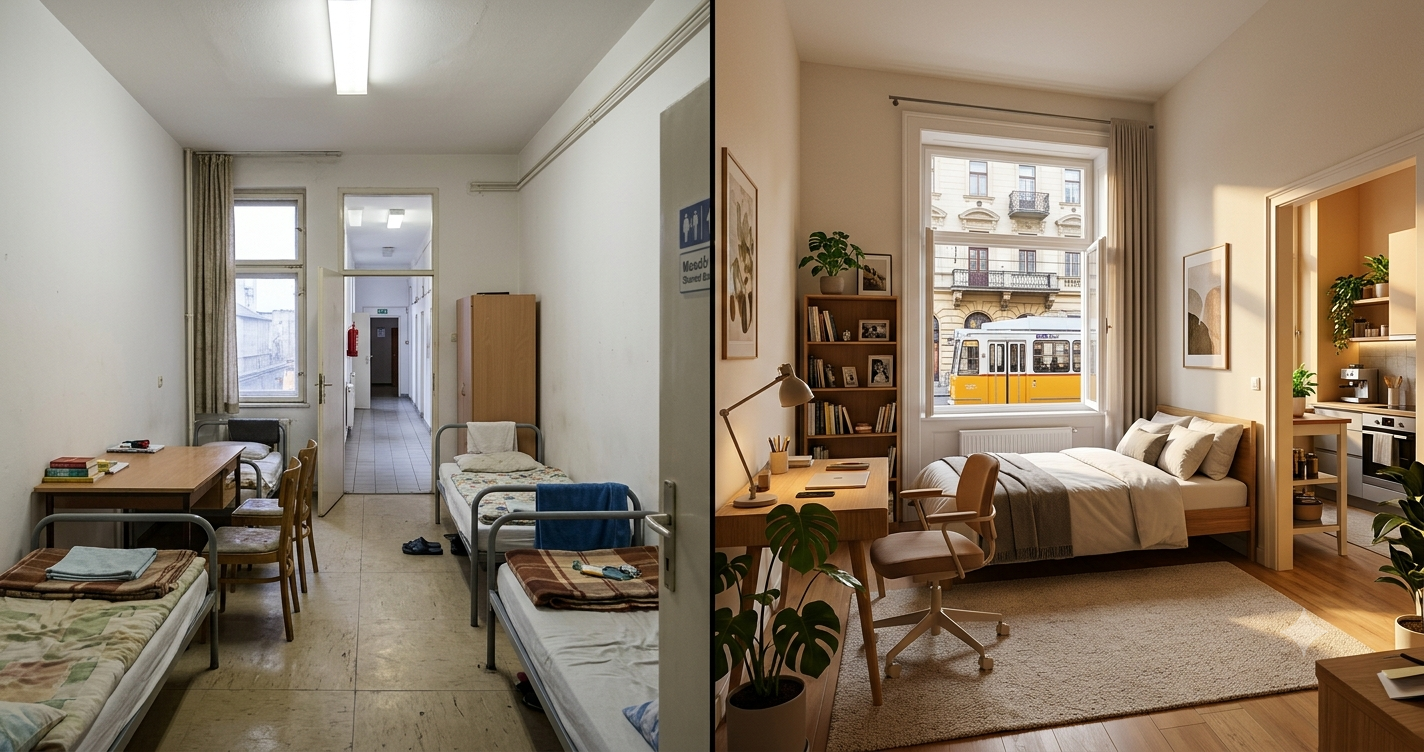
If you're heading to Budapest for Erasmus, an exchange semester, or a full degree, the dorm-or-coliving question comes up early, usually right after you've been accepted and before you've worked out where you're actually going to sleep. Both options put you around other students. Beyond that, they work quite differently.
Here's how they actually compare in Budapest specifically, not in the abstract.
The Short Answer
A university dorm is usually the cheapest option on paper, if you can get one. Coliving costs a bit more but comes with price certainty, guaranteed availability, and a private room from day one. For a single semester or an Erasmus exchange, coliving is generally the safer bet. For full-degree students who secure a dorm place early and don't mind shared rooms, the dorm can make sense financially.
What Budapest University Dorms Actually Look Like
Budapest's major universities, ELTE, BME, Corvinus and Semmelweis, all run their own kollégium (dormitory) system. These are generally the cheapest housing option in the city, but they come with real constraints worth knowing before you count on one.
- Rooms are typically shared: two, three or four students to a room, with shared bathrooms and kitchens on the corridor or floor
- Spots are allocated by the university, usually through an internal application with limited places, and enrolled full-degree students are prioritised over exchange and Erasmus arrivals
- Rent is often low, commonly in the €100 to €250 per month range, but this frequently doesn't include all bills, and Wi-Fi quality varies by building
- Move-in and move-out dates are tied to the academic calendar, not to your specific semester, so a dorm isn't always available for the exact 5 or 6 months you need
If your university offers you a dorm place and the dates line up with your stay, it's worth considering purely on price. The trade-off is that you generally can't choose your room, your roommates, or guarantee the length of contract you actually want.
What Coliving in Budapest Actually Looks Like
Coliving, like what Fuse offers in Budapest, puts you in a private bedroom within a shared home of roughly 7 to 15 students, with communal spaces like a kitchen, lounge and sometimes a gym or outdoor area. Every room is fully furnished, and the monthly price includes rent, utilities and WiFi in one number.
The other difference is choice. You pick your contract length (5, 6, 10 or 12 months), your move-in date, and your room, rather than being assigned whatever the university has left. Every resident goes through an application process, so you're living with other students who've also been through it, not whoever happened to get allocated to your floor.
Cost Comparison
On the surface, dorms win on price. A Budapest kollégium room can run as low as €100 to €250 per month, well under coliving. But the comparison isn't quite that simple once you account for what's actually included and what isn't.
An all-inclusive coliving room in Budapest, like Fuse's, runs roughly €450 to €480 per month, covering rent, all utilities, WiFi and access to communal spaces. A dorm room at €150 with bills separate and patchy WiFi can end up closer to €220 to €250 once you add those back in, still cheaper, but a meaningfully smaller gap than the headline price suggests.
The bigger cost risk with dorms isn't the monthly number, it's not getting one at all. If your application doesn't come through, or you're an exchange student lower down the priority list, you'll be looking at the private rental market on short notice, which in Budapest runs €300 to €500 per month for a private room, well above either option above.
Who Actually Gets a Dorm Spot
This is where the dorm route gets harder for exactly the students who'd benefit most from a semester abroad. Erasmus and exchange students are usually last in line behind enrolled full-degree students, and allocations are often confirmed only weeks before term starts, sometimes after you've already needed to make other arrangements. If you're planning a single semester and need certainty before you book flights, this timeline is a real practical problem, not just an inconvenience.
Privacy and Room Setup
Dorm rooms in Budapest are typically shared between two and four students, with a shared bathroom and kitchen down the hall. It's a genuinely social setup, but privacy is limited and you don't get to choose who you're sharing a room with.
Coliving gives you your own private bedroom from day one, with shared spaces reserved for the kitchen, lounge and common areas rather than the bedroom itself. If personal space matters to you as much as community does, this is the more significant difference between the two, more than the price gap.
Flexibility and Contract Length
University dorms run on the academic calendar. If your semester doesn't match the university's own term dates exactly, you may end up paying for weeks you don't need, or scrambling for alternative housing at the edges of your stay.
Coliving contracts at Fuse are fixed-term: 5, 6, 10 or 12 months, matched to your actual dates rather than the university's. If you're doing one Erasmus semester, a 5 or 6 month contract lines up with your programme directly, without the guesswork.
Which One Actually Makes Sense
A few quick ways to decide:
- Doing a single Erasmus or exchange semester and want certainty before you book flights: coliving
- Starting a full degree and comfortable waiting on a university allocation: a dorm application is worth trying alongside a coliving backup
- Want your own private room and don't want to share with strangers assigned by the university: coliving
- Prioritising the lowest possible monthly cost above everything else and can tolerate shared rooms and academic-calendar timing: a dorm, if you get one
One Thing Worth Knowing Before You Decide
Dorms aren't guaranteed and the timeline for finding out is often too late to be useful for semester planning. Applying for a dorm place while also holding a coliving booking as backup, one you can commit to and know your dates work either way, is a common and sensible approach for students who want to try the cheaper option without gambling their whole semester on it.
You can check current availability and pricing for Budapest coliving at Fuse's listings page.
Frequently Asked Questions
Can Erasmus students get a dorm room in Budapest?
Sometimes, but enrolled full-degree students are usually prioritised, and spots for exchange and Erasmus students are limited and often confirmed close to term start. It's not something to rely on for firm semester planning.
Is coliving more expensive than a university dorm in Budapest?
On the headline monthly price, usually yes. Once you add back separate utilities and WiFi that many dorms don't include, the real gap is smaller than it first appears, and coliving includes guaranteed availability and your own private room.
Do Budapest university dorms include utilities and WiFi?
It varies by university and building. Many dorms charge utilities separately, and WiFi quality and cost also vary. Always confirm the full monthly cost, not just the advertised rent, before comparing.
Can I get a private room in a Budapest dorm?
Rarely. Most kollégium rooms house two to four students. If a private room matters to you, coliving or a private apartment are the more reliable options.
What happens if my dorm application in Budapest doesn't come through?
You'll likely be looking at the private rental market on short notice, which runs €300 to €500 per month for a private room in Budapest and requires more legwork to arrange from abroad. Booking a coliving room in advance avoids this risk entirely.