Coliving vs Dorm in Riga: Which Actually Makes Sense?
Dorm or coliving in Riga? Here's how cost, privacy, flexibility and community actually compare, so you can pick the right fit for your semester.
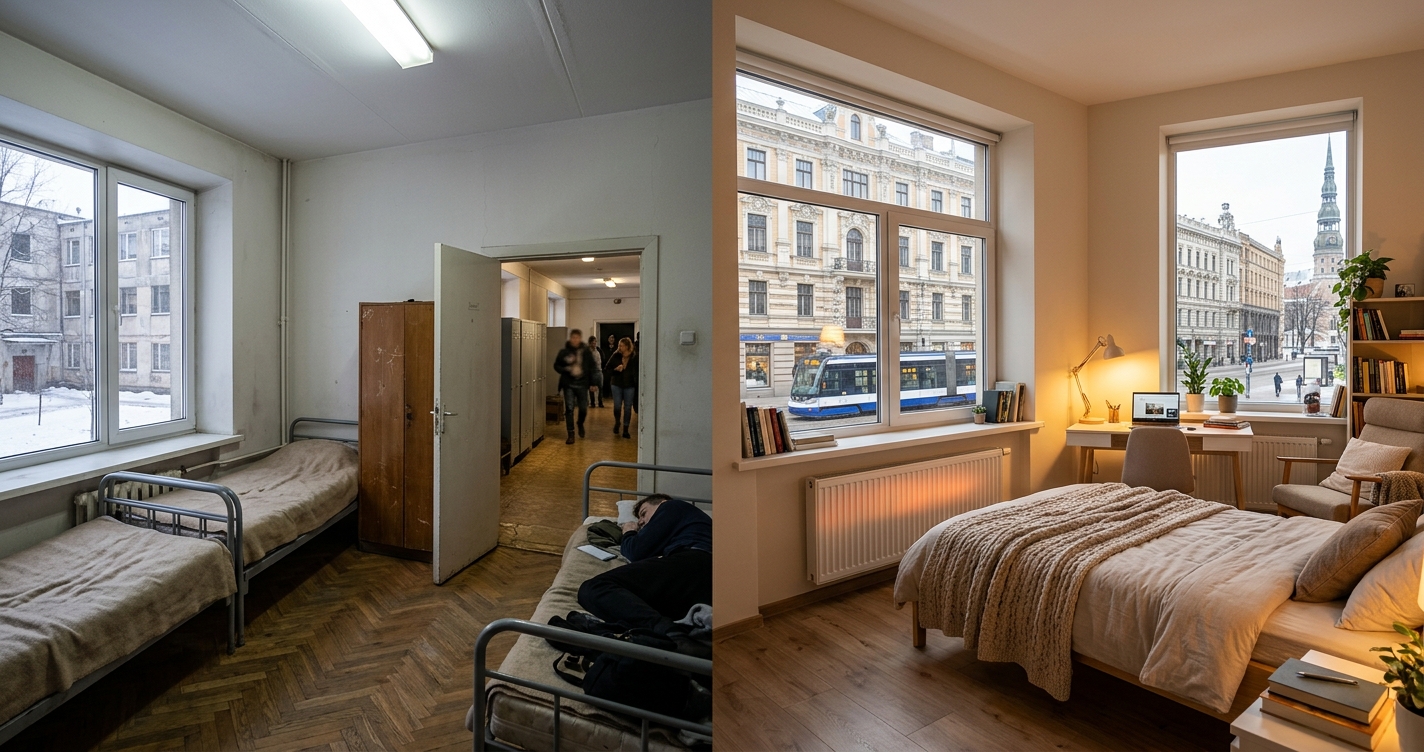
Riga's universities, RSU, RTU and the University of Latvia among them, all offer dormitory housing (kopmītne), and it's usually the first option students look at, mostly because it's cheap and it's offered directly by the university. Coliving is the newer alternative, and for a lot of students arriving from abroad, it ends up being the more practical one.
Here's the actual comparison, not the version that just repeats "dorms are cheaper."
The Short Answer
A university dorm in Riga is usually the lowest sticker price, if you can secure one and if the dates match your stay. Coliving costs somewhat more but comes with a guaranteed private room, fixed pricing, and a contract length that matches your actual semester. For international and exchange students booking from abroad, coliving tends to be the lower-risk choice.
What Riga University Dorms Actually Look Like
RSU, RTU and the University of Latvia each run their own dormitories, generally the cheapest housing option available to enrolled students. A few things worth knowing before counting on one:
- Rooms are usually shared, often two students per room, with communal bathrooms and kitchens on the floor
- Spots are limited and allocated by the university, with enrolled full-degree students generally prioritised over exchange and Erasmus students
- Rent tends to be low, often in the €100 to €200 per month range, but utilities aren't always included and can add a meaningful amount, especially through Riga's colder winter months
- Availability and move-in dates follow the academic calendar, which doesn't always match the exact 5 or 6 month window of a single exchange semester
RSU in particular draws a large international and exchange student population, which means demand for its dorm places is high and confirmation can come later than students booking from abroad would like.
What Coliving in Riga Actually Looks Like
Coliving, like what Fuse offers in Riga, gives you a private bedroom in a shared home with other students, alongside communal spaces like a kitchen and lounge. The monthly price is all-inclusive: rent, utilities and WiFi bundled into one number, with no separate bills landing once winter heating kicks in.
You choose your contract length (5, 6, 10 or 12 months), your move-in date and your room, rather than waiting on a university allocation. Every resident goes through an application process, which means the people you're living with have too.
Cost Comparison
Riga dorms are genuinely inexpensive on paper, often €100 to €200 per month. But bills are frequently separate, and Riga's winters are harsher than Budapest's, regularly dropping to minus ten to minus fifteen degrees in January and February, which pushes heating costs up noticeably for anyone not on an all-inclusive price.
An all-inclusive coliving room in Riga runs somewhat higher than a bare dorm rate, but it removes that seasonal swing entirely, the same number in September and in February. If your dorm application doesn't come through, the private rental market in Riga is also the more difficult one to navigate remotely, since much of it runs through Latvian-language platforms and local contacts rather than English-language listings.
Who Actually Gets a Dorm Spot
This is the practical sticking point. Enrolled full-degree students are typically prioritised over exchange and Erasmus arrivals, and Riga's private rental market is one of the harder ones in the region for international students to navigate without local contacts or language. If your dorm application falls through close to your move-in date, your fallback options are more limited in Riga than in a market like Budapest, where there's a larger and more English-friendly private rental scene.
Privacy and Room Setup
Dorm rooms in Riga are typically shared, often two to a room, with communal bathroom and kitchen facilities down the hall. It's a workable, social setup, but you don't choose your roommate and privacy is limited.
Coliving gives you a private bedroom from the start, with shared spaces limited to the kitchen and communal areas. If having your own space matters as much as meeting people, this is the bigger practical difference between the two options, more than the price gap.
Flexibility and Contract Length
Dorm availability follows the university's academic calendar rather than your specific programme dates, which can leave a gap at either end of a single semester. Coliving contracts at Fuse are fixed-term, 5, 6, 10 or 12 months, matched to your actual stay rather than the institution's own term dates.
Which One Actually Makes Sense
A few quick ways to decide:
- Doing a single exchange semester and booking from abroad: coliving, for the certainty and the matching contract length
- Starting a full degree at RSU, RTU or University of Latvia and comfortable waiting on an allocation: worth applying for a dorm place, ideally with a coliving booking as backup
- Want a private room without navigating Riga's local-language rental market: coliving
- Prioritising the absolute lowest monthly cost and can tolerate shared rooms and academic-calendar timing: a dorm, if you get one
One Thing Worth Knowing Before You Decide
Dorm confirmations in Riga often land later than international students booking flights would like, and the private market fallback is genuinely harder to navigate from abroad than in some other CEE cities. Applying for a dorm while holding a coliving booking you're comfortable committing to either way is a sensible approach if you want to try the cheaper option without leaving your whole semester's housing to chance.
You can check current availability and pricing for Riga coliving at Fuse's listings page.
Frequently Asked Questions
Can exchange students get a dorm room in Riga?
Sometimes, but enrolled full-degree students are generally prioritised, and RSU in particular has high demand from its large international student population. Confirmation can come later than students booking from abroad would prefer.
Is coliving more expensive than a university dorm in Riga?
On the advertised monthly rate, usually yes. Once you factor in separate utilities and Riga's colder winters, the real gap narrows, and coliving includes a guaranteed private room and fixed pricing year-round.
Do Riga university dorms include utilities?
It varies by university and building. Many charge utilities separately, which can add up meaningfully during winter. Confirm the full monthly cost, not just the advertised rent.
Can I get a private room in a Riga university dorm?
Rarely. Most dormitory rooms are shared, often two students per room. If a private room matters, coliving or a private apartment are more reliable options.
What happens if my dorm application in Riga doesn't come through?
You'd likely be navigating Riga's private rental market, which relies heavily on Latvian-language platforms and local contacts, harder to arrange remotely. Booking a coliving room in advance avoids this risk.