Prague and Vienna Are Next: What Students Can Expect from Fuse's Upcoming Cities
Fuse is expanding to Prague and Vienna. Here's what both cities are like, what housing costs, and what to expect.
Prague and Vienna Are Next: What Students Can Expect from Fuse's Upcoming Cities
Budapest and Riga are where Fuse started. Prague and Vienna are where we're going next.
Both cities are on the Fuse site as "Coming Soon," and we get a lot of questions from students who are planning ahead. What are the cities like? What does housing cost? What should they know before they go? This post answers all of that, so students who are looking at Prague or Vienna for their next semester know exactly what they're walking into.
Prague: The City That Speaks for Itself
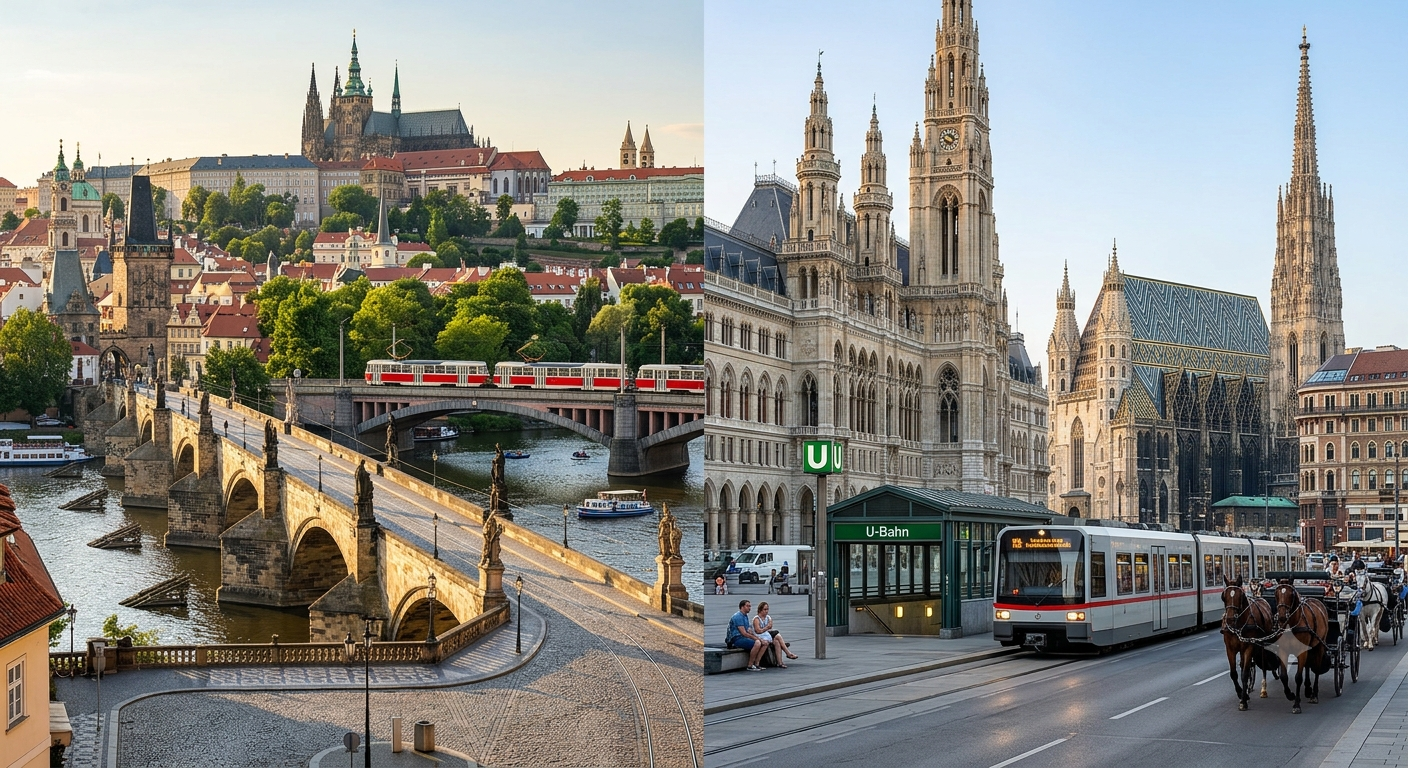
There's a reason Prague is one of the most searched Erasmus destinations in Europe. The city is objectively beautiful in a way that few capitals are, Charles University is one of the oldest in the world, and the cost of living is dramatically lower than most Western European cities despite Prague not feeling like a compromise in any sense.
The Old Town, the castle, the bridge, the Jewish Quarter: this is the version of Prague that brings students here for a semester and makes them want to extend. But it's the day-to-day version of the city that keeps them. Good coffee, excellent food, a nightlife scene that ranges from jazz clubs to rooftop bars, and the kind of compact, walkable layout that means you end up knowing your neighbourhood within a week.
What housing costs in Prague right now
The honest version: Prague has gotten more expensive over the past few years, and the gap between it and truly cheap CEE cities like Riga or Krakow has narrowed. But it's still a long way behind Western Europe.
A private room in a shared flat in a decent area of Prague (Districts 2, 3, 6, 7) runs roughly €300 to €500 per month. Studios run from €400 up to €700 for something newer or more central. University dormitories at Charles University and the Czech Technical University start lower, often €150 to €300 per month, but availability is limited and prioritised for enrolled students before Erasmus arrivals.
One thing that catches students off guard: private rental agencies in Prague charge a commission of around 50% of one month's rent on top of the first month and deposit. This doesn't apply to managed operators or purpose-built student housing. Budget for it if you're going the private route.
Total monthly budget for a student in Prague: €700 to €900, which puts it in a similar range to Budapest and Riga.
The Czech koruna
Prague uses CZK, not the euro. Revolut and Wise both handle the conversion cleanly. Current exchange rate is roughly 25 to 27 CZK per euro, but check before you go since it moves. Almost all tourist and student-facing businesses accept cards, so you don't need to hold a lot of cash.
Universities drawing international students to Prague
Charles University is the biggest name and the broadest in terms of programmes. Czech Technical University (ČVUT) for engineering and technology. Prague University of Economics and Business (VSE) for business and economics students. The University of Chemistry and Technology for science and pharmaceutical students.
Getting around
Prague's metro, tram and bus network is excellent. A monthly student pass is one of the better value transit deals in CEE. The 22 tram line running from the city centre out to the castle district and back is worth taking just for the view, but it's also genuinely useful for students living in Districts 3, 5 or 6.
Vienna: A Different Kind of Student City
If Prague feels like a discovery, Vienna feels like a statement. It has been voted the most livable city in the world multiple times over. It is the city of Mozart, Freud, Klimt, and the world's oldest continuously operating zoo. It has a transit system that costs €1 a day for unlimited access to everything in the city. And it has two universities in the QS global top 200.
Vienna is more expensive than Prague or Budapest. A room in a shared apartment starts around €350 and rises to €700 depending on district and quality. The total monthly budget for a student in Vienna sits between €1,100 and €1,400, which is higher than CEE alternatives but significantly lower than Paris, Amsterdam or Zurich. For the quality of life and the infrastructure, a lot of students consider it worth the difference.
What makes Vienna feel different from other student cities
The obvious answer is the architecture, but the practical answer is the transit. The Jahreskarte (annual transit pass) costs €365 for everyone, which is exactly €1 per day. That's not a student discount: it's the regular price, available to everyone, covering the entire metro, tram and bus network including night services. Students in Vienna don't think about commuting in the way students in larger, patchier cities do. You just get on the U-Bahn and go.
Vienna is also genuinely multicultural in its student population. The University of Vienna and WU Vienna together have tens of thousands of international students, which means the city is experienced at handling the logistics of students arriving from abroad.
The main student districts
Josefstadt (8th) and Alsergrund (9th) sit around the University of Vienna and have the strongest student neighbourhood feel. Neubau (7th) for design, cafés and TU Wien proximity. Leopoldstadt (2nd) for a younger, more varied energy with good transport. Wieden (4th) and Mariahilf (6th) as solid all-rounders. The U4 and U6 lines serve most of these efficiently.
Address registration (Meldezettel)
Students staying longer than three months in Austria are required to register their address at the local Magistratsabteilung 35 office. This is needed for a bank account, certain administrative tasks, and official residency confirmation. Managed operators handle this as part of onboarding. It's a straightforward process but worth knowing about in advance.
What Fuse in Prague and Vienna Will Look Like
The same model that works in Budapest and Riga: fully furnished rooms, all utilities and WiFi included in a single monthly price, fixed-term contracts of 5, 6, 10 or 12 months, an application process that creates a vetted community of housemates rather than a random lottery, and direct access to the Fuse team through the tenant dashboard rather than a landlord who responds when they feel like it.
Both cities need this. Prague's private rental market is navigable but opaque for students booking from abroad, especially with agency fees and Czech-language listing platforms. Vienna's market is strong but competitive, and the best managed housing options fill early. Fuse's remote-first booking process and fixed all-inclusive pricing are the same answer to the same problem in a new geography.
We're not announcing a specific launch date here. What we can say is that students planning for 2026/27 and beyond should bookmark both cities on the Fuse site and check back as availability opens.
If You're Heading to Prague or Vienna Before Fuse Launches
In the meantime, socials.homes covers verified student housing across both cities and is the platform we recommend for finding something before Fuse is live there. Every listing goes through a verification process before going up, which matters in a market like Prague where the informal and agency-heavy private rental market has some real pitfalls.
For Budapest and Riga, you can book with Fuse now. Browse rooms at fusestays.com.
Frequently Asked Questions
Is Fuse currently available in Prague or Vienna?
Not yet. Both cities are listed as "Coming Soon" on fusestays.com. Fuse currently operates in Budapest and Riga.
When will Fuse launch in Prague and Vienna?
We haven't announced a specific date. Students planning ahead should check fusestays.com for updates.
What will Fuse's pricing look like in Prague and Vienna?
Prague housing costs currently run around €300 to €500 for a private room. Vienna runs €350 to €700. Fuse's all-inclusive model will sit competitively within those ranges when it launches, consistent with the approach in Budapest and Riga.
Where can I find verified student housing in Prague or Vienna right now?
Socials.homes covers both cities with verified listings and is the recommended platform until Fuse is live there.
What contract lengths will Fuse offer in Prague and Vienna?
The same model as Budapest and Riga: fixed-term contracts of 5, 6, 10 or 12 months with rent paid monthly. Exact availability will depend on room type and launch timing.