Getting Around Budapest as a Student: The Complete Transport Guide
Metro, trams, night buses, the student pass and airport transfers, everything you need to get around Budapest as a student.
Budapest's transport pass comes up constantly in cost breakdowns as one of the best deals in Europe, but nobody actually explains how the network works, how to get the discount, or what to do at 2am when the metro's closed. Here's the full picture.
The Network: Metro, Trams and Buses
Budapest's system, run by BKK, covers three metro lines, an extensive tram network, buses and trolleybuses, all on the same ticket or pass. The tram network does a lot of the heavy lifting for students specifically: the 4 and 6 run along the Grand Boulevard (Nagykörút) 24 hours a day and connect most of the districts students actually live in, Districts VI, VII, VIII and IX, without needing to touch the metro at all. If you're commuting to a university near the centre, there's a good chance a single tram gets you there directly.
The Student Pass and How to Actually Get It
The discounted monthly Budapest pass for students costs 3,450 HUF, roughly €9, compared to 8,950 HUF for the standard adult pass. To qualify, you need a student card from a higher education institution in an EU member state (or Iceland, Liechtenstein, Norway or Switzerland) with a photo and visible expiry date, an ISIC card also works. From 15 June 2026, EU and EEA student ID holders also need to show an official document confirming your address in Hungary (a lakcímkártya) or an accommodation certificate from the Hungarian immigration authorities, worth sorting early since it's a new requirement.
You can buy the pass through the BudapestGO app, at BKK Customer Service Points (including one at the airport), or from ticket vending machines around the city. Keep your student card on you when you travel, inspectors will ask to see it alongside your pass.
Night Transport
Once the metro closes for the night, Budapest switches to a dedicated night bus network that runs until around 5am. The most useful central lines are 907, 914, 950, 979 and 990, and they're covered by the same pass you already have, no separate night fare. Frequency drops compared to daytime, so budget more waiting time than you would during the day.
Getting To and From the Airport
The 100E Airport Express bus connects Liszt Ferenc International Airport to Deák Ferenc tér in the city centre in about 30 minutes. It runs 24 hours a day: roughly every 10 minutes during the day, and every 30 to 40 minutes between midnight and 3:30am. A one-way ticket costs around €5.5 (2,200 HUF) if you're paying separately, though it's covered by a valid monthly pass if you already have one. It's a considerably cheaper option than a taxi for a first arrival with luggage.
Cycling: MOL Bubi
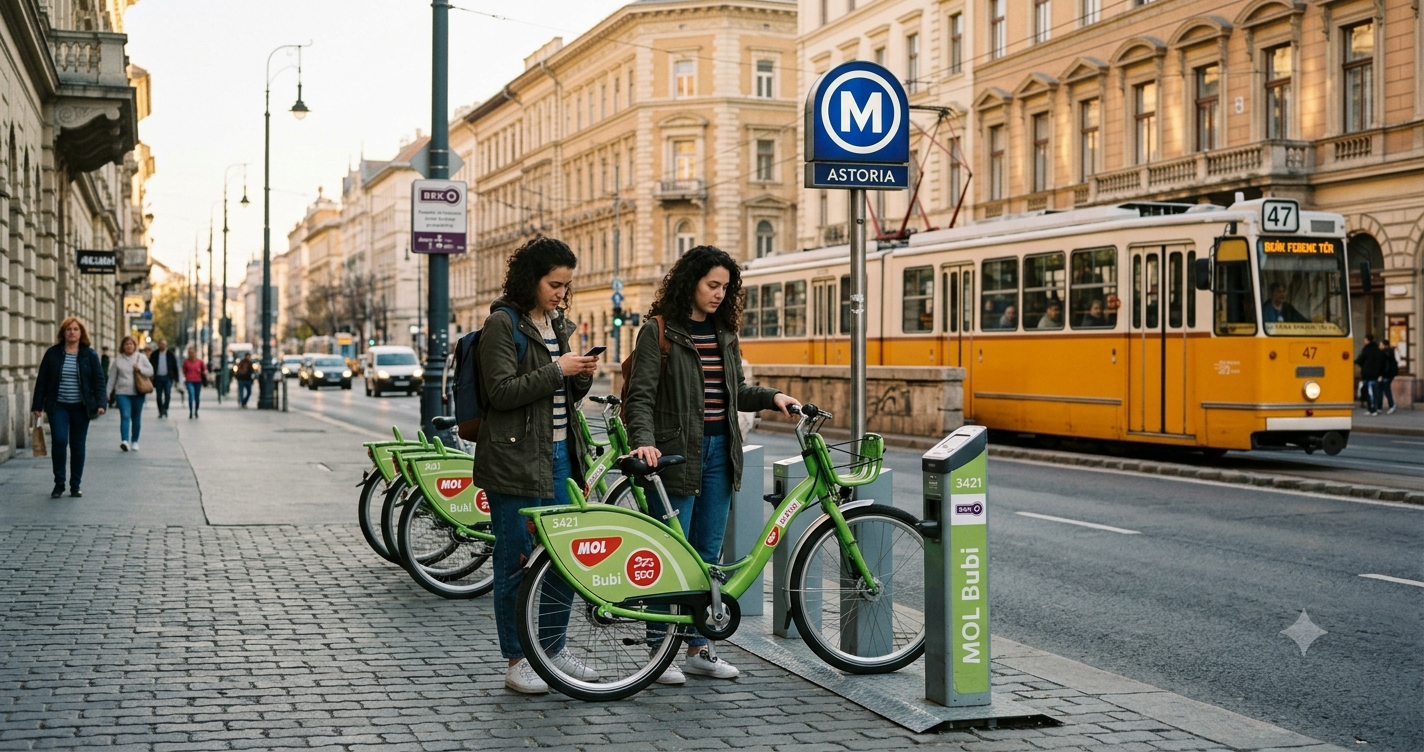
Budapest's public bike-share system, MOL Bubi, operates around the clock across the city. You register at molbubi.hu before your first ride and then purchase a pass. It's a solid option for short hops that don't quite justify a tram, or for exploring on a nice day without committing to owning a bike for a semester.
How This Connects to Fuse's Buildings
Fuse's buildings sit in three different pockets of the city, and the transport picture looks a little different from each. Near Thököly út, you're close to Keleti station, one of the best-connected points in the city for metro and tram lines heading in almost any direction. Near Visegrádi utca in Újlipótváros, the 4 and 6 tram line is close by along with metro access, a genuinely easy commute to most university areas. Near Gát utca in Ferencváros, you're within walking distance of both tram and metro connections into the centre, handy for Corvinus University specifically.
Frequently Asked Questions
How much is the student transport pass in Budapest?
3,450 HUF a month, roughly €9, with a valid EU student card or ISIC. The standard adult pass is 8,950 HUF, so the student discount is substantial.
Do I need anything besides my student card to get the discount?
From 15 June 2026, EU and EEA student ID holders also need proof of address in Hungary, either a lakcímkártya or an accommodation certificate from Hungarian immigration. Worth arranging this early after you arrive.
Is there a night bus network in Budapest?
Yes, running until around 5am on the same pass as daytime travel. Lines 907, 914, 950, 979 and 990 cover the most central routes, though frequency is lower than during the day.
What's the cheapest way to get from the airport to the city centre?
The 100E Airport Express bus, running 24 hours a day to Deák Ferenc tér in about 30 minutes, covered by a valid monthly pass or around €5.5 as a one-way ticket.
See available rooms in Budapest