Best Student Neighborhoods in Budapest: A 2026 Guide for International Students
Where should you live in Budapest as a student? A district by district guide to rent, vibe and commute, matched to your university and budget.
Budapest is one of the great student cities in Europe. Affordable, beautiful, packed with international students, and built around a public transport system that genuinely works. It is also a city of 23 numbered districts, each with its own personality, price tag and commute reality. Picking from the best student neighborhoods in Budapest is the single most important decision you will make before your semester starts, and it deserves more than ten minutes of scrolling Google Maps.
This guide walks through the districts that actually matter for students, what each one is really like, and how to match your choice to your university, your budget, and the kind of semester you want to have.
Quick orientation: Buda vs Pest, and which side you'll live on
Budapest is split in two by the Danube. Buda, on the west bank, is hilly, leafy, more residential and noticeably quieter. Pest, on the east bank, is flat, dense, full of bars and ruin pubs, and where most universities and student life actually happen. With a few exceptions (BME, parts of ELTE), most students live in Pest, partly for the commute and mostly for the social life.
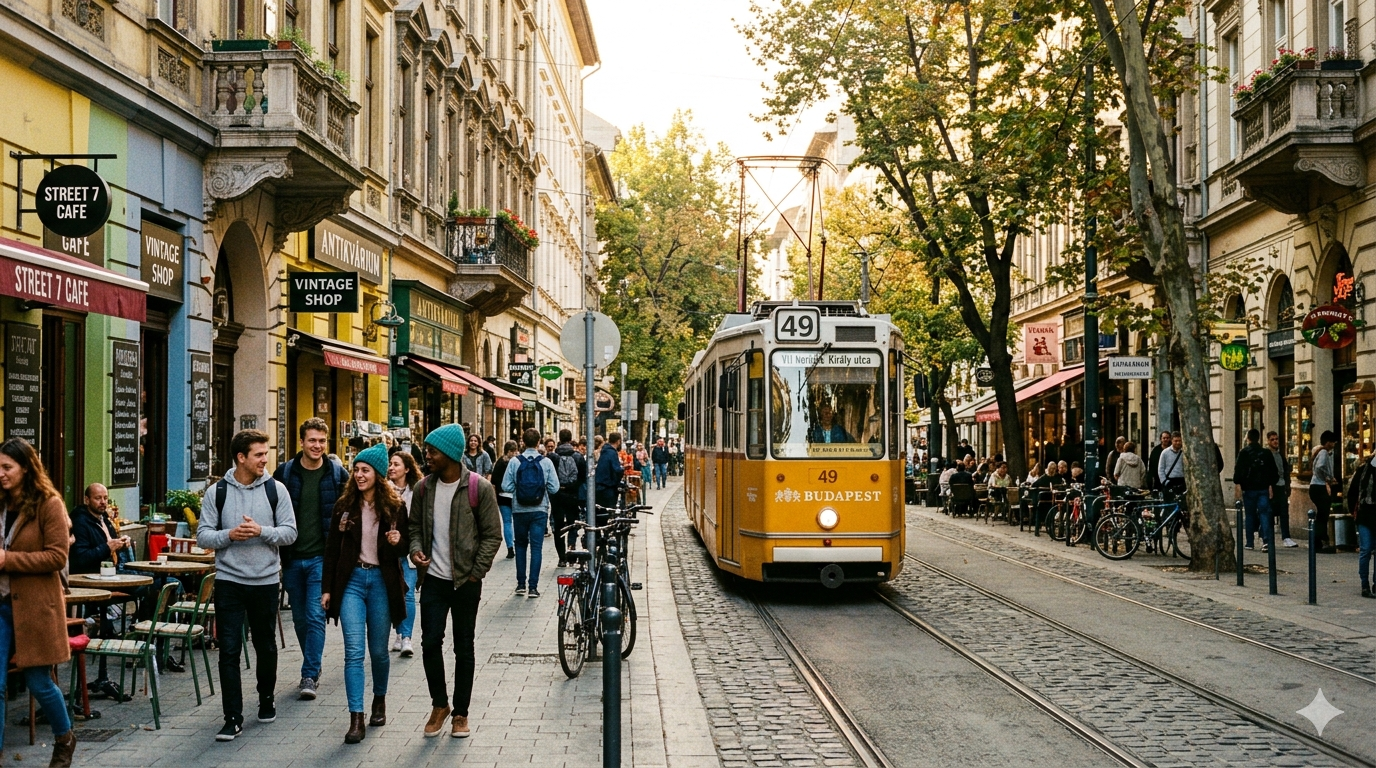
Districts are numbered with Roman numerals (District V, District VII, and so on) and you will see them written both ways. Public transport is excellent and cheap: a monthly student pass costs roughly 3,400 HUF (about €9), and the metro, trams and night buses connect almost everything. The 4 and 6 trams run 24/7 along the Grand Boulevard and are basically the spine of student life. Living within a five minute walk of a 4/6 stop is a huge quality of life upgrade.
District V (Belváros / Lipótváros): central, beautiful, expensive
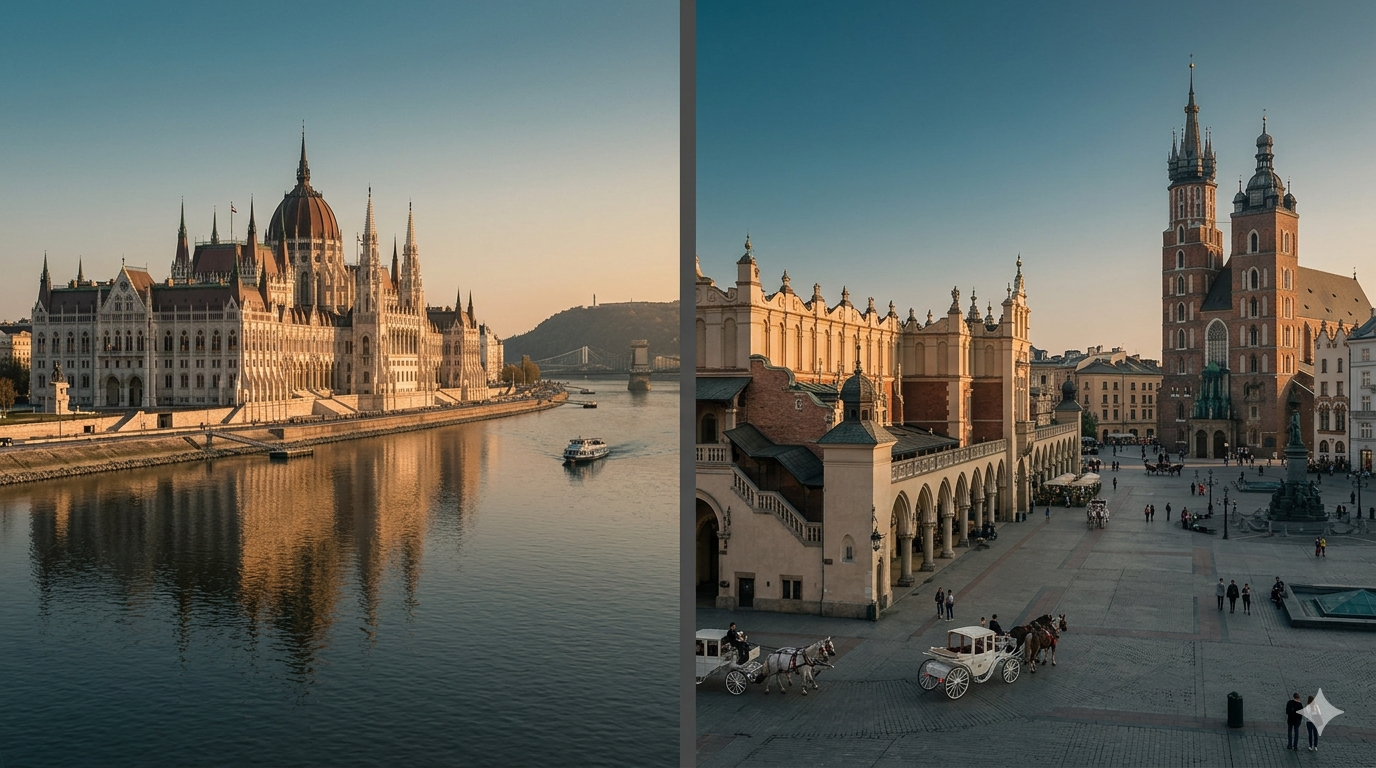
District V is the historic core of Pest. Parliament, the Danube promenade, the Chain Bridge and most of the city's grand 19th century architecture sit here. It is walkable to almost everything, safe at all hours, and home to Central European University (CEU), so if you study there, this is your zone.
The catch is price. District V commands the highest student rents in the city: expect €450 to €650 for a private room in a shared flat, €700 to €950 for a studio. Worth it if you can afford it and want a polished, postcard Budapest experience. Less ideal if your budget is tight or you want a louder, more student heavy vibe.
District VI (Terézváros): the cultural middle ground
District VI sits just northeast of District V and runs along Andrássy Avenue, Budapest's tree lined answer to the Champs Élysées. It is home to the State Opera, the Liszt Academy of Music, theatres, design shops and a strong café culture. Central without being touristy, lively without being chaotic.
Rents here run €400 to €550 for a room, €600 to €800 for a studio. A particularly good fit for music, arts and humanities students at ELTE or the Liszt Academy, and a sensible all rounder if you want centre of the action living without going full District V on price.
District VII (Erzsébetváros): the party district everyone knows
District VII is the Jewish Quarter and the international byword for Budapest nightlife. The famous ruin bars (Szimpla Kert, Instant Fogas, Mazel Tov, dozens more) cluster here. Street food courts, vintage shops, late night kebabs and a constant rotating cast of Erasmus students and digital nomads define the place. This is where most exchange students gravitate by default, and where searches for student rooms in Budapest's 7th district keep climbing.
Rents are reasonable for how central it is: €350 to €500 for a room, €600 to €800 for a studio. The trade off is noise. If you sleep with the window open and have an 8am class, District VII will not love you back. Live a few streets east of Király utca (toward Dob or Wesselényi) for the vibe with slightly fewer 3am bottle clinks. Or just invest in earplugs, like most locals do.
District VIII (Józsefváros): student value, especially the Palace District
District VIII has a more complicated reputation than most Budapest districts. The northern part, known as the Palace District (Palotanegyed), is genuinely lovely, with grand 19th century buildings, leafy squares, the Hungarian National Museum and a quietly growing student and creative scene. The southern parts get rougher, and most international students stay north of Baross utca.
Crucially, this is where a lot of universities actually sit: ELTE's Trefort kert campus (most ELTE humanities and law), Semmelweis University's main medical campus, and Pázmány Péter Catholic University all sit in or border District VIII. Rents are €300 to €450 for a room and €500 to €700 for a studio, a meaningful discount on District V or VII while often being a five minute walk to class.
District IX (Ferencváros): practical, well connected, increasingly popular
District IX runs south along the Danube from the centre. The northern part, near the Liberty Bridge, has become one of the most strategic districts for students because it is where Corvinus University of Budapest sits, plus much of Semmelweis. It is well served by the M3 metro, the 4/6 tram, and a growing roster of cafés, restaurants and modern apartment buildings along the river.
Rents run €350 to €500 for a room and €550 to €750 for a studio. The vibe is less party focused than VII or VIII and feels more like a real neighbourhood, with locals doing their grocery runs, dog walkers along the Danube and a Saturday market at Bálna. If you are at Corvinus or you want a calmer Budapest that is still ten minutes by tram from the action, this is the obvious choice.
District XI (Újbuda): only really makes sense if you're at BME
Cross the Liberty or Petőfi bridge to the Buda side and you arrive in District XI (Újbuda), home to BME (Budapest University of Technology and Economics) and ELTE's Lágymányos campus. If you study engineering, IT or natural sciences, this is where your lecture halls are, and living here means a ten minute walk to class instead of a 30 minute tram ride from Pest.
Rents are noticeably lower than central Pest: €280 to €420 for a room, €500 to €650 for a studio. The trade off is that Újbuda is more residential and quieter at night. You will cross the bridge for District VII nights out, which costs you a tram ride and about 20 minutes. Most BME students decide it is a fair trade.
District XIII (Újlipótváros): quiet, safe, underrated
District XIII sits just north of District V along the Danube. It is a planned 20th century neighbourhood, with wide streets, Bauhaus apartment buildings, Margaret Island right on your doorstep (excellent for running), and a calm, family friendly feel that some students actively want. The M3 metro connects you to the centre in five minutes.
Rents run €350 to €500 for a room and €600 to €800 for a studio. Best for students who prioritise sleep, a stable routine and easy access to green space over being inside the Erasmus chaos. Worth a serious look if you have already done a loud city centre semester elsewhere and want something more grown up.
Matching your university to a district
A quick cheat sheet:
- ELTE (Trefort kert, law and humanities): Districts VIII, VII, V or VI
- ELTE (Lágymányos, sciences) and BME: District XI; Districts V or XI for a longer commute with more lifestyle
- Corvinus University: District IX (right next door) or V
- Semmelweis University: Districts VIII or IX
- Central European University (CEU): District V
- Liszt Academy: District VI
- Multiple campuses or undecided: Districts VII, VIII or IX, all of which give you flexibility
Practical tips before you sign anything
A few things worth knowing as you compare options for student accommodation in Budapest:
- Heating (rezsi) is the hidden cost. Hungarian winters are cold and utilities can swing your monthly bill by €50 to €120 between summer and February. Always confirm whether rent is all bills included (rezsivel együtt) or net (rezsi nélkül).
- The deposit is usually two months rent, not one. Higher than students from many countries expect. Get the inventory in writing and photograph everything on move in day.
- Avoid Facebook Marketplace scams. Budapest has one of the most active fake listing scenes in CEE. Never wire a deposit before viewing the flat (in person or via verified video call), and prefer platforms that verify landlords.
- Book early for September starts. Budapest's student market tightens from late June. Erasmus students arriving without housing booked routinely end up stuck in hostels for weeks.
- Consider coliving. Purpose built coliving for students in Budapest has grown significantly in the last few years and bundles rent, utilities, internet and community events into one transparent monthly price. Useful if you don't speak Hungarian and don't want to negotiate a local language lease as your first task in the city.
The short version
If you want one rule of thumb: District VII if you came here to party, District V if budget isn't a constraint, District VIII or IX for the best value with a short commute to most universities, District XI only if BME is your campus, District XIII if you want a quieter semester. Pick the neighbourhood that fits the rhythm you actually want, not the one your friend recommended for their semester in 2019. Budapest rewards students who live close to the city's energy, and at €9 a month for unlimited transport, almost every district on this list is closer than it looks.
Looking for verified, all-inclusive student housing in Budapest? Browse Fuse's rooms and studios across the city's best districts.