Budapest vs Krakow for Erasmus Students: Which City Should You Choose?
Budapest or Krakow for your Erasmus semester? Compare cost, universities, nightlife, housing, travel and weather to find the city that fits you.
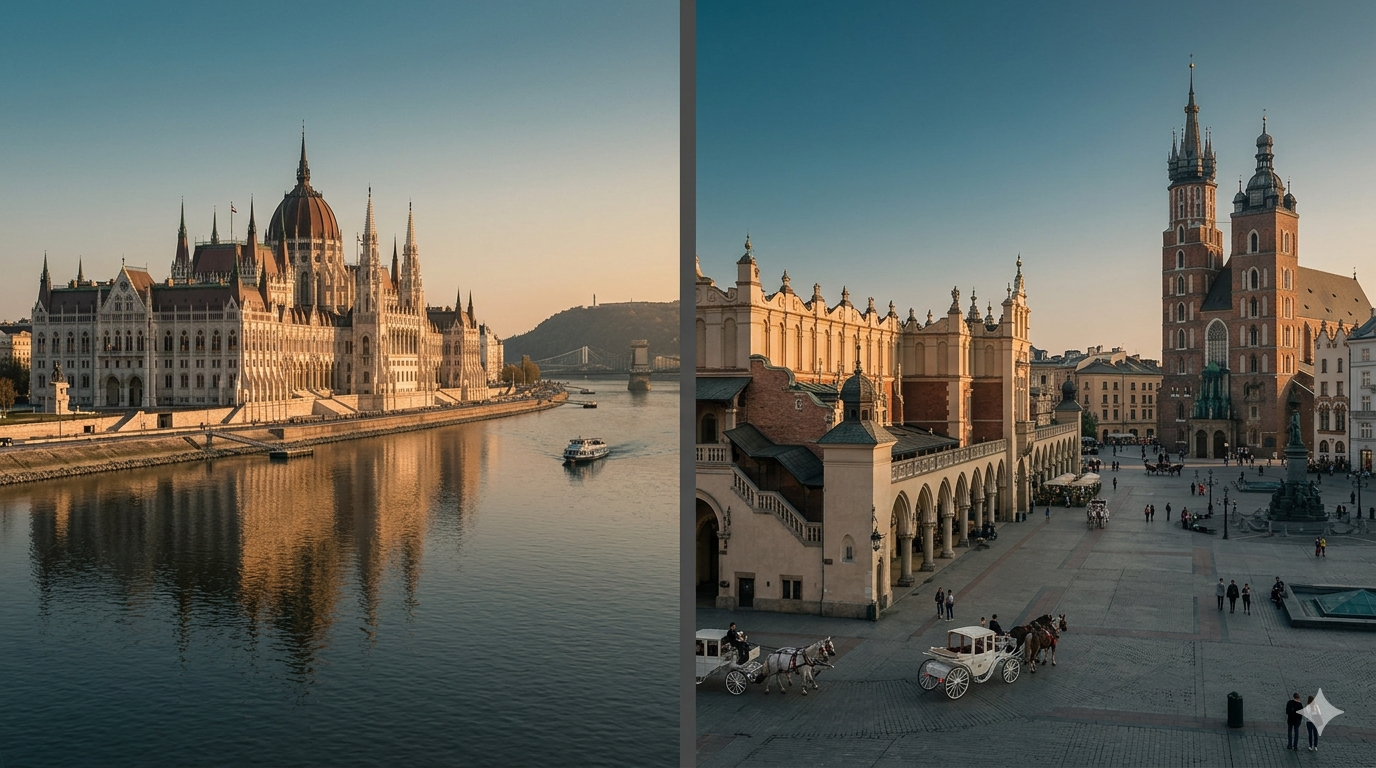
Of the dozen or so Central and Eastern European cities Erasmus students seriously consider, two come up again and again at the top of the shortlist: Budapest and Krakow. Both are affordable. Both have world class universities. Both have UNESCO listed old towns, lively student scenes, and the kind of café culture that makes writing essays in public feel like a lifestyle choice. So the real question of Budapest vs Krakow for Erasmus students comes down to texture. Which city's particular energy is going to suit the semester you actually want to have?
This guide breaks down both cities across the things that genuinely matter, meaning cost, universities, nightlife, housing, travel and weather, and helps you work out which one is the right pick for you.
Cost of living: both cheap, Budapest slightly cheaper
Let's get the money question out of the way first, because it is where most students start. By European standards both cities are very affordable. By each other's standards, Budapest is the cheaper option. Expatistan's March 2026 data puts the cost of living in Krakow roughly 22% higher than in Budapest, and student specific comparisons show a similar gap.
Rough monthly numbers for a typical Erasmus student:
- Budapest: €500 to €700 total monthly budget (rent, food, transport, social life)
- Krakow: €600 to €850 total monthly budget for the same lifestyle
A private room in a shared flat runs €300 to €500 in Budapest and €310 to €450 in Krakow, so housing itself is broadly comparable. The bigger gap shows up in restaurants, groceries and bars. Hungary has stayed slightly cheaper than Poland on day to day expenses, particularly for eating out. A typical mid tier restaurant meal in Budapest runs €8 to €12, in Krakow more like €10 to €15.
Public transport monthly student passes are another notable gap: roughly €9 in Budapest, around €15 in Krakow.
Verdict on cost: Both cities crush Western European prices. If your budget is genuinely tight, Budapest gives you more breathing room. If you have a normal Erasmus grant of €350 to €500 a month, either city is comfortable.
Universities: different strengths, both academically serious
Budapest's heavy hitters are spread across multiple specialisations. Semmelweis University is one of the top medical schools in Central Europe, with a strong international cohort. Corvinus University dominates business and economics. ELTE is the country's largest university and covers humanities, sciences and law. BME handles engineering and technology. Central European University (the part that stayed in Budapest after the political dispute) remains a respected social sciences institution.
Krakow's academic identity is more concentrated around one institution: Jagiellonian University, founded in 1364, the second oldest university in Central Europe after Charles University in Prague. It is a serious research institution with strong humanities, social sciences, law and medicine. AGH University of Science and Technology covers engineering and tech and is well respected regionally.
Verdict on universities: If you are studying medicine, business or engineering, Budapest's specialised universities probably carry a stronger international reputation in your specific field. If you are in humanities, law or social sciences, Jagiellonian's gravitas is hard to match. For most other subjects it is roughly a wash.
Nightlife: Budapest wins decisively
This one isn't really close. Budapest's nightlife is internationally famous, and Erasmus students arrive in part to experience it. The ruin bars (romkocsmák), built inside abandoned buildings, courtyards and pre war tenements, are unique to the city. Szimpla Kert is the original, and there are now dozens more clustered in District VII, the Jewish Quarter. Thermal bath parties on Saturday nights at Széchenyi are another only in Budapest experience. Drinks are cheap, the scene runs late, and most of it is concentrated in a walkable area that international students can navigate in their first week.
Krakow's nightlife is genuinely good. Kazimierz, the old Jewish quarter, has a dense cluster of bars and clubs, and Polish vodka culture keeps prices excellent. But it is more of a regular European university town scene than a global destination. You will have a great time. You won't have travel blogger anecdotes about thermal bath parties.
Verdict on nightlife: Budapest, clearly. If nightlife is in your top three reasons for choosing a city, this should weigh heavily.
Culture and daytime life: Krakow has the edge
Krakow is one of Europe's most aesthetically perfect cities. The Rynek Główny (Main Square) is the largest medieval square in Europe, the Wawel Castle complex is genuinely spectacular, the Old Town is fully walkable, and the whole place feels like a Renaissance painting somebody forgot to take down. Kazimierz brings the bohemian character. The proximity to Auschwitz Birkenau, the Wieliczka Salt Mine, the Tatra Mountains (two hours away in Zakopane) and the Polish national parks gives you weekends of substance for the entire semester.
Budapest is also beautiful, with the Parliament building, the Danube, the Castle District and the bridges, but it is a bigger, denser, more metropolitan experience. Less of a fairytale, more of a real capital city.
Verdict on culture: Krakow for the daytime, postcard, museum and castle experience. Budapest for the broader urban energy.
Housing: similar markets, similar problems
Both cities have student housing markets that work the same way: a mix of university dorms (cheap, basic, hard to get as an exchange student), private rentals via Facebook groups (cheap, risky, occasionally scammy), and a growing wave of purpose built student accommodation and coliving (more expensive, all-inclusive, English language leases, easy to book before arrival).
Krakow has slightly more developed purpose built student accommodation thanks to operators like SHED and Tribera Living that have built modern student focused buildings in the last few years. Budapest is catching up fast but still leans more on the private rental market.
Practical timing is similar: start looking in April or May for a September arrival. Both markets tighten significantly by July. Heating bills are a real concern in both cities and can swing your monthly costs by €80 to €150 in winter if utilities are billed separately, so always confirm whether your rent is all bills included.
Verdict on housing: Roughly comparable. Slight edge to Krakow on availability of modern, internationally targeted student housing.
Location and weekend travel: Krakow's central position wins
Krakow is geographically central in CEE. Weekend trips include Prague (6 hours by train), Berlin (8 hours), Vienna (4 hours), the Tatra Mountains (2 hours), Wrocław (3 hours), Warsaw (2.5 hours) and Bratislava (5 hours). Cheap buses and trains make spontaneous weekends realistic on a student budget.
Budapest is further east, which limits some weekend options but opens others. Vienna is closer (2.5 hours), Bratislava is an easy day trip (2.5 hours), Belgrade is reachable (7 hours), and the wine regions of Eger and Tokaj are domestic weekends. Less convenient if you want to bounce around Central Europe, great if you want to explore the Balkans.
Verdict on travel: Krakow for variety, Budapest for depth in fewer directions.
Weather: both cold, Krakow colder
Both cities have proper continental winters. Budapest is slightly milder, with January averages around 0°C, snow but not a lot of it. Krakow averages a few degrees colder and gets more snow, often heavily, from December through March. Summers in both cities are warm to hot (25 to 32°C in July and August). If you have strong opinions about winter coats, Krakow is the more demanding pick.
Which city should you pick?
The honest summary, after all of the above:
- Choose Budapest if you came to Erasmus primarily for the social life, the nightlife matters to you, you are studying medicine, business or engineering, you want the slightly cheaper option, and you are happy in a bigger, denser, busier city.
- Choose Krakow if you want a more compact, walkable, picture perfect city, you are in humanities, law or social sciences, you want to do a lot of weekend travel across Central Europe, you would rather be in a real student town than a metropolis, and you don't mind a colder winter.
Both are excellent choices. The Erasmus students who end up unhappy in either city are almost always the ones who picked based on what other people told them to pick, rather than which semester they actually wanted to have. Decide which version of the experience fits you, book your housing early, and stop overthinking it. Both cities are going to give you one of the best semesters of your life.
Looking for verified, all-inclusive student housing in Budapest, Krakow, or other Central and Eastern European cities? Browse Fuse's rooms and studios across the region.