What Is Coliving? Everything Students Need to Know Before Booking
What coliving is, what's included, what it really costs and how it compares to a university dorm, so you can decide before you book a room abroad.

Coliving is professionally managed shared housing: you rent your own furnished room, share the kitchen and lounge with other residents, and pay rent, bills and Wi Fi in one monthly price. If you have been hunting for student accommodation and the word coliving keeps showing up, you are not imagining it. It has become one of the fastest growing housing options in Europe, and students keep choosing it for a simple reason. It solves a problem that ordinary renting just doesn't.
So what is coliving, really? Is it a house share with a nicer name? A lifestyle brand for people who want a rooftop terrace and a kombucha tap in the kitchen? And does it actually make sense for a student on a real budget? This guide walks through all of it so you can decide properly before you book anything.
So, What Is Coliving?
Coliving is a housing model where you get your own private room or studio and share the communal spaces with everyone else in the building. The kitchen, the lounge, sometimes a rooftop or a gym. You keep your own space behind a door that locks, but you live alongside other people who are in the same situation as you.
The thing that sets it apart from a regular house share isn't the shared kitchen. It is how the whole thing is run. In a normal house share, someone is chasing the landlord about a broken boiler, someone forgot to top up the electricity, and a passive aggressive note about the dishes has been stuck to the fridge for three weeks. In coliving, a management team handles all of that. Bills are included. Maintenance gets sorted without five follow up emails. You move in and get on with your life.
The model was designed for people who are new to a city, don't have a local support network yet, and want the simplicity of one monthly payment that covers everything with no nasty surprises three months in. That describes a lot of international students almost exactly, which is a big part of why all-inclusive student accommodation has spread so quickly across European cities.
Where Did Coliving Come From?
Coliving isn't a new idea. Communal living has existed in one form or another for decades, from student halls to intentional communities to the old boarding house model. What changed over the last ten years is that purpose built, professionally managed coliving grew into a real housing industry rather than a niche or a compromise.
Cities like Berlin, Amsterdam, Lisbon and Barcelona saw the first wave of modern coliving operators arrive between roughly 2015 and 2018, mostly because their private rental markets had become genuinely unaffordable for young people moving from abroad. Coliving filled the gap. Furnished, flexible, all in, with a social environment built into the building. It spread quickly because it worked.
Today it is mainstream enough that most major European cities have several coliving options, and the quality has climbed a long way as the sector matured. It is no longer a last resort or a stopgap. For plenty of students and young people, it is a deliberate first choice.
What's Actually Included
This is where coliving starts to make real sense for international and Erasmus students. When you are moving to a new city from abroad, the last thing you want is to spend your first week opening a dozen accounts and contracts before you have even found your lecture hall.
A standard coliving package gives you a fully furnished room, all utilities covered (electricity, heating, water), WiFi that already works when you arrive, regular cleaning of the communal areas, and access to shared spaces like kitchens and lounges. Contracts are fixed term and usually line up with the academic calendar, so you are not pushed into a generic 12 month tenancy when you only need five or six months.
Some operators go further with regular community events, organised move in days, welcome packs, or extras like a gym and outdoor space. The level of inclusion varies between providers, so it is worth checking the specifics before you book.
At Fuse in Budapest and Riga, the furnished room, utilities and fast Wi Fi come in one monthly payment, and residents share the cleaning of common areas. Beyond the rent, the only costs are a one off €295 membership fee and a refundable deposit, and in Budapest a fair use limit applies to utilities. That is genuinely rare in student housing, where the headline price and the real cost are often two very different things.
Coliving vs Renting a Private Apartment
Here is an honest comparison.
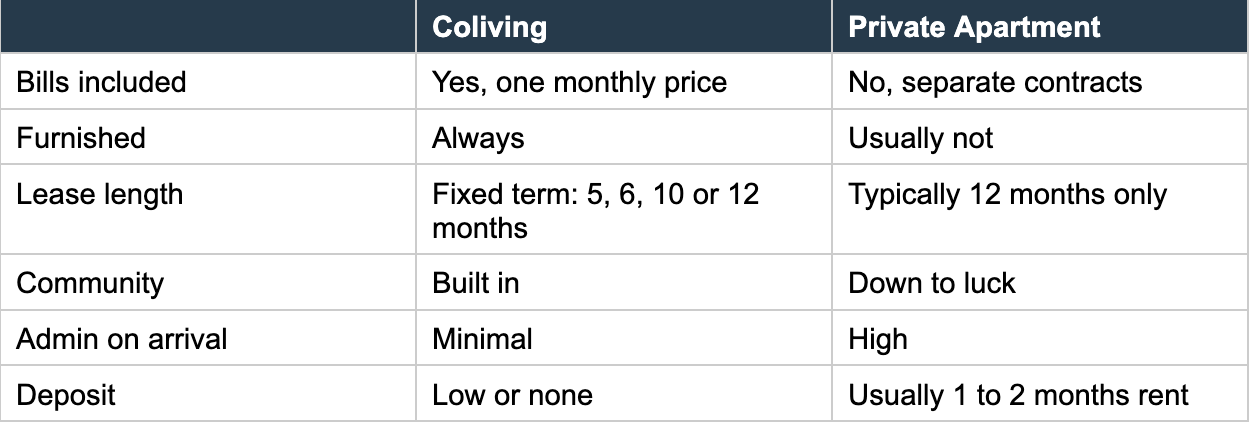
For someone arriving in a new country, the private apartment route means opening utility accounts, buying furniture, and negotiating a lease, often in a language that isn't your first. Not impossible, but it eats real time and energy that most students don't have spare in the opening weeks of a semester abroad.
The price comparison shifts once you add everything up honestly too. A room advertised at €300 a month with bills separate is rarely €300 by the time you have added electricity, heating, WiFi and a deposit. More on that in the cost section below.
Then there is what happens when something breaks. In a private apartment you are at the mercy of a landlord who might be slow, hard to reach, or simply unhelpful. In a well run coliving space, maintenance requests go to a management team that has every reason to keep the building in good shape. Small things, but they stack up over a five month stay.
Coliving vs Student Dorms
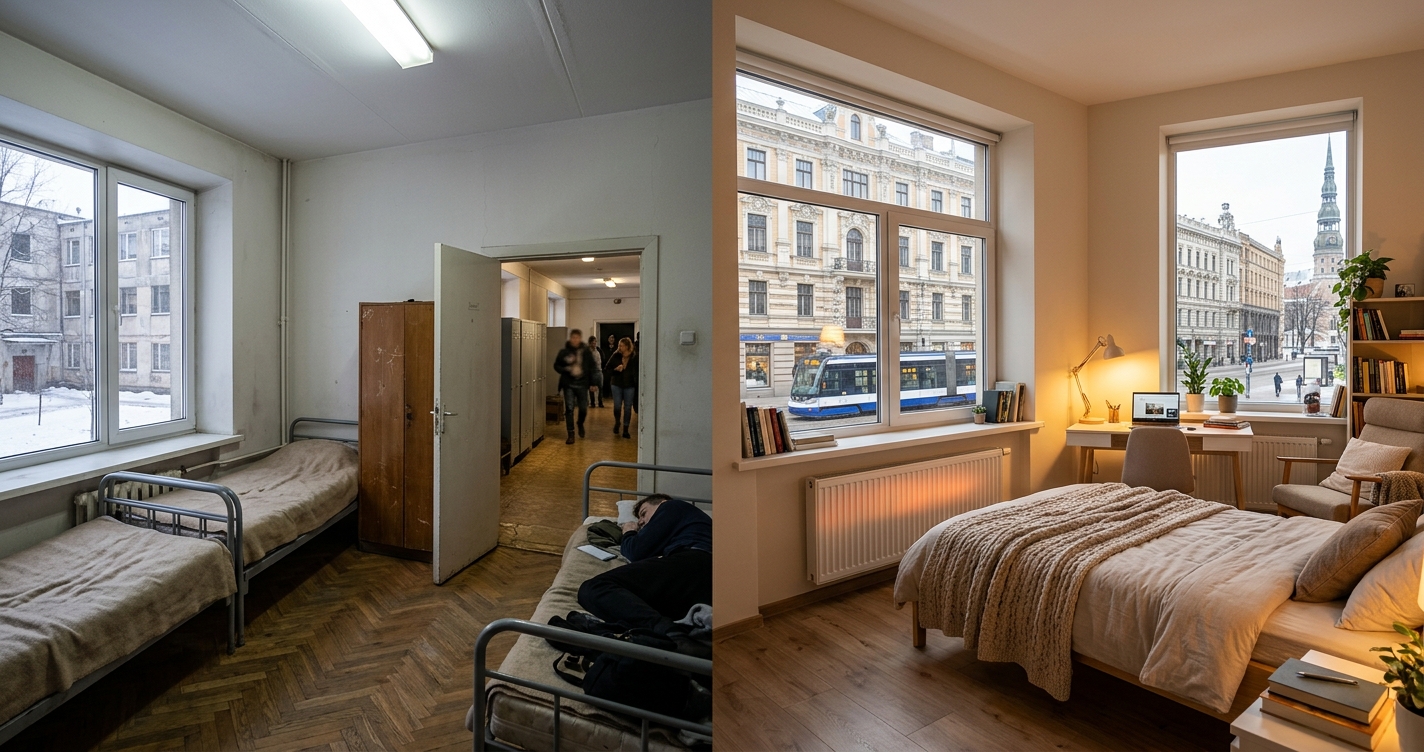
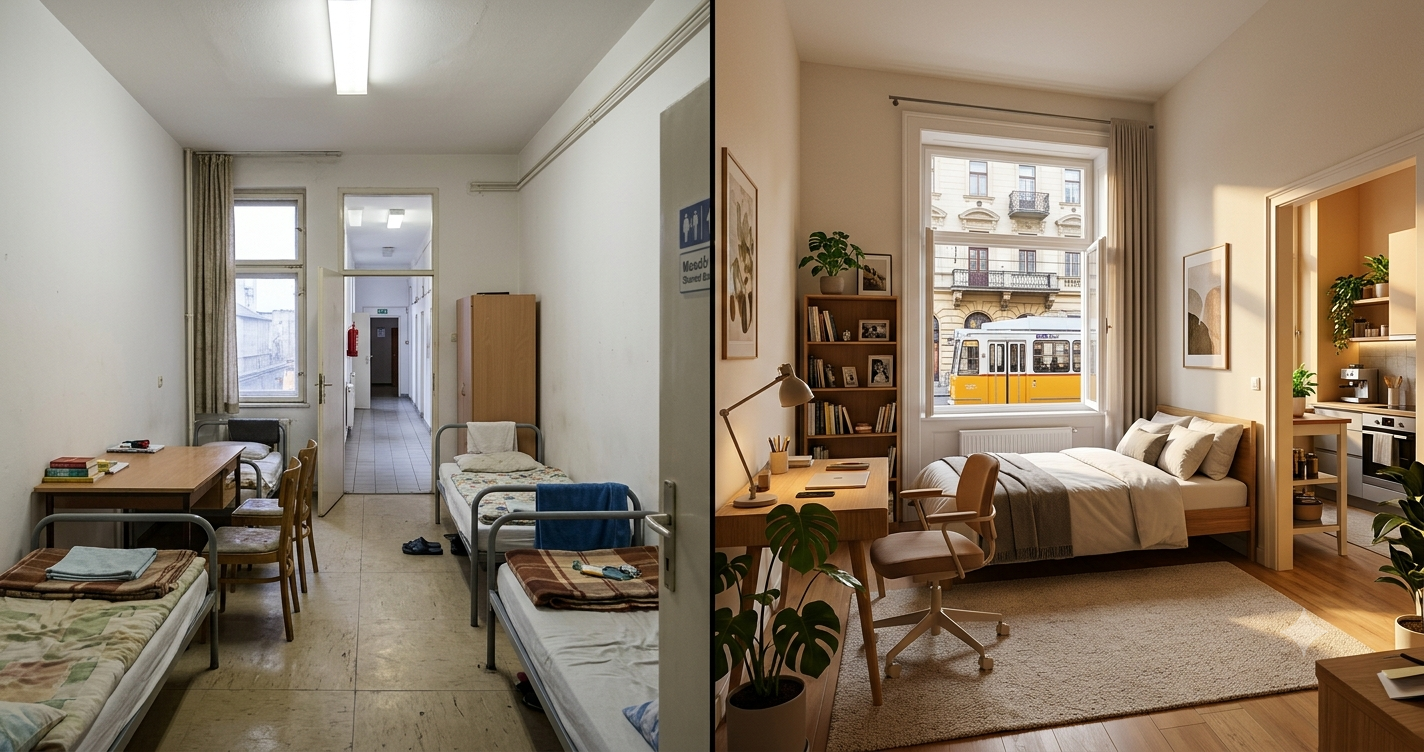
Dorms deserve credit. They are social, usually on or near campus, and the first week energy in a hall of residence is hard to beat. But they come with real limits that don't always get said out loud.
Most university dorms are only open to students enrolled at that specific institution. International and Erasmus students often find they don't qualify, or they land on a waiting list longer than their whole exchange. Even when you get a place, the rooms tend to be smaller, the contracts less flexible, and the check in dates are set by the university rather than by you.
There is also a ceiling to the dorm experience that most students hit around week four. Once the novelty fades, you are in a small room with institutional furniture, sharing a corridor bathroom with twenty people, eating whatever the canteen put out that week. Fine for a while. Not always where you want to be for an entire semester.
Coliving gives you the social side of dorm life without those restrictions. You still move into a building full of people who are new to the city and keen to meet others. The communal kitchen is still where the friendships happen. But you choose your neighbourhood, your move in date, and how long you stay. The rooms are better, the spaces are more comfortable, and you are not waiting on a university housing office to fix your problems.
Coliving vs dorms at a glance
- Privacy: dorm rooms are small and often shared, with bathrooms and kitchens used by the whole floor. In coliving you usually get your own room, and fewer people share each kitchen. Edge: coliving.
- Cost: dorms win on the headline price. In Budapest, for example, an ELTE dorm place costs 50,000 to 70,000 HUF a month (about €135 to €190) in a shared room for 2026/27, bills included. Coliving costs more but bundles your own furnished room, utilities and Wi Fi into one predictable price. Edge: dorms on price, coliving on what you get for it.
- Location: dorms sit on or near campus. Coliving is in the city, which in compact student cities like Budapest and Riga rarely means a long commute. Edge: dorms for campus, coliving for the city.
- Social life: dorms put you among students from day one, but the noise is hard to escape. Coliving gives you a community you can step back from when you need quiet. Edge: coliving, if you want community on your own terms.
- Flexibility: dorm contracts follow the academic year and rarely bend. Coliving lets you pick your dates; at Fuse that means 5, 6, 10 or 12 months. Edge: coliving.
- Admin: dorms go through your university, often with priority groups, waiting lists and late decisions. Coliving can be booked online from abroad as soon as you know your dates. Edge: coliving, for students booking from abroad.
- Quality: dorm standards vary a lot by building. Coliving operators compete for residents, so standards tend to be more consistent, but always read reviews. Edge: coliving, in most cases.
Who should choose a dorm?
A dorm makes sense if it is much cheaper than anything else in your city, you study on one big campus where walking to class matters, you want a fully university based social life, or your university guarantees you a place in a building you know is good.
Who should choose coliving?
Coliving is the better fit if you arrive without a social network, want one all inclusive price with no admin surprises, value a private room to retreat to, have dates that don't match the academic year, or don't want to set up utility accounts in a language you don't speak.
Why International Students Keep Choosing It
Moving abroad looks completely manageable right up until you are doing it. You are learning a new university, a new language, a new transit system and a whole new pile of admin, and somewhere in the middle of that you need to sort out where you will sleep and whether you will know anyone by week three.
Coliving handles the housing side cleanly. The part that gets talked about less is what it does for the social side, because loneliness when you first arrive is real and it catches a lot of students off guard. You land in a new city, everyone back home carries on without you, the group chats are full of conversations you can't join, and the first weekend with nowhere to be and no one to call is genuinely tough.
When you move into a coliving home, everyone around you is in the same position. Other internationals, other Erasmus students, other people still working out which tram goes where and whether the corner shop takes cards. The shared spaces stop being just somewhere to cook and become where you meet the people you spend the semester with.
Good operators design for this on purpose. The layout of the communal areas, the events in the first few weeks, the mix of residents, the way move in is structured, all of it points at making the transition easier and the community real rather than a word on a website. Fuse builds its homes in Budapest and Riga around exactly this. The community isn't an afterthought. It is the point. You can read more at fusestays.com.
Is Coliving Actually More Expensive?
On paper, a coliving room can look pricier than the cheapest private room on a listings site. But you are not comparing the same thing, and the maths changes once you are honest about what you are adding up.
Take that €280 room you found online. Add utilities, which climb every winter once the heating comes on. Add WiFi. Add a deposit that might be two months rent upfront, money you may not see again for a long time depending on the landlord. Add the cost of furnishing a room that comes with nothing, because private rooms at that price rarely include so much as a desk lamp. You are past the coliving price before you have bought a mattress, and you did far more work to get there.
Coliving gives you one number. That number doesn't change in February when the heating bill lands. There is no end of month panic about whether the electricity account still has credit. For students on a fixed budget, especially one set by an Erasmus grant that arrives once a month and doesn't stretch, the predictability matters as much as the price itself.
What to Look For When Choosing a Coliving Space
Not all coliving is the same standard, so it is worth knowing what to check before you commit.
Start with the basics. Make sure everything described as included is actually written into the contract. If there is a fair use limit on utilities, it should be written in the contract with the exact allowance, so you know what is covered. A "flexible lease" is only flexible if the break clause is genuinely short. Read what you are signing.
Then think about location relative to where you will actually spend your time. Coliving in a cheap area that is 45 minutes from your university is technically cheaper but rarely a better deal once you count the commute in time and money.
Look closely at the communal spaces. A shared kitchen matters a lot when it is where you cook most meals and where most of the social life happens. A photo tells you something, not everything, so look for reviews or testimonials from people who have actually lived there.
Finally, weigh up the mix of residents. A building that is mostly long term renters rather than students and short stay internationals will have a very different social energy. If community matters to you, and for most students moving abroad it does, ask who else lives there.
Who Is It Actually Right For
Coliving is a strong fit if you are an international or Erasmus student who wants to arrive somewhere new without spending the first fortnight on admin and buying a frying pan. If you are on a semester length programme and don't want to be locked into a 12 month lease that outlives your stay. If you don't have a friend group lined up in the city and want a realistic shot at meeting people from day one.
It is probably not for you if you want total solitude, already have specific people you want to share a flat with, or are planning a long stay where you want to fully personalise the place. Coliving is a managed environment, and that is the trade off. For most students on a typical Erasmus or exchange programme, it is well worth it.
How to Find Coliving in Europe
Start by searching for coliving or student residences in the city you are moving to, then check every operator the same way: a registered company, a written contract in English, a clear list of what the monthly price includes, and reviews from past residents. Fuse, for example, is rated 4.4 out of 5 on Trustpilot from 58 reviews. Pay only to a verified company with a written contract.
For students heading to Budapest or Riga specifically, Fuse offers all inclusive rooms in Budapest and Riga on contracts of 5, 6, 10 or 12 months. Rooms start at €380 a month in Budapest and €250 in Riga. The only extras are a one off €295 membership fee and a refundable deposit. Both cities sit among the most affordable Erasmus destinations in Europe, and all-inclusive housing in that price range makes the monthly budget far easier to manage than almost anything you will find in Western Europe.
Frequently Asked Questions
Sources
Every figure in this article comes from these pages, checked on October 11, 2026.