Student Housing in Central and Eastern Europe: Best Cities for 2026
Why Central and Eastern Europe is the smart place to study in 2026: sourced living costs, the best student cities, how the housing market works and what to sort before you fly.

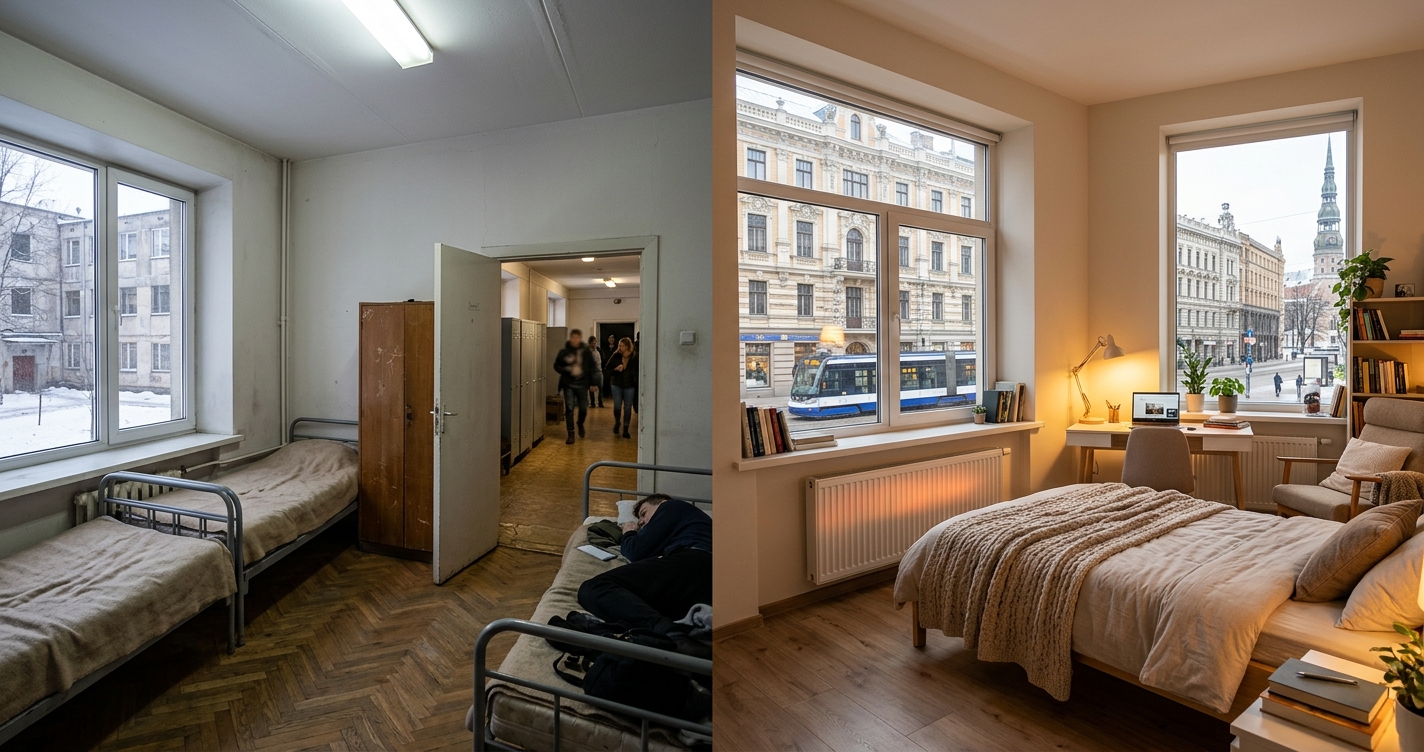
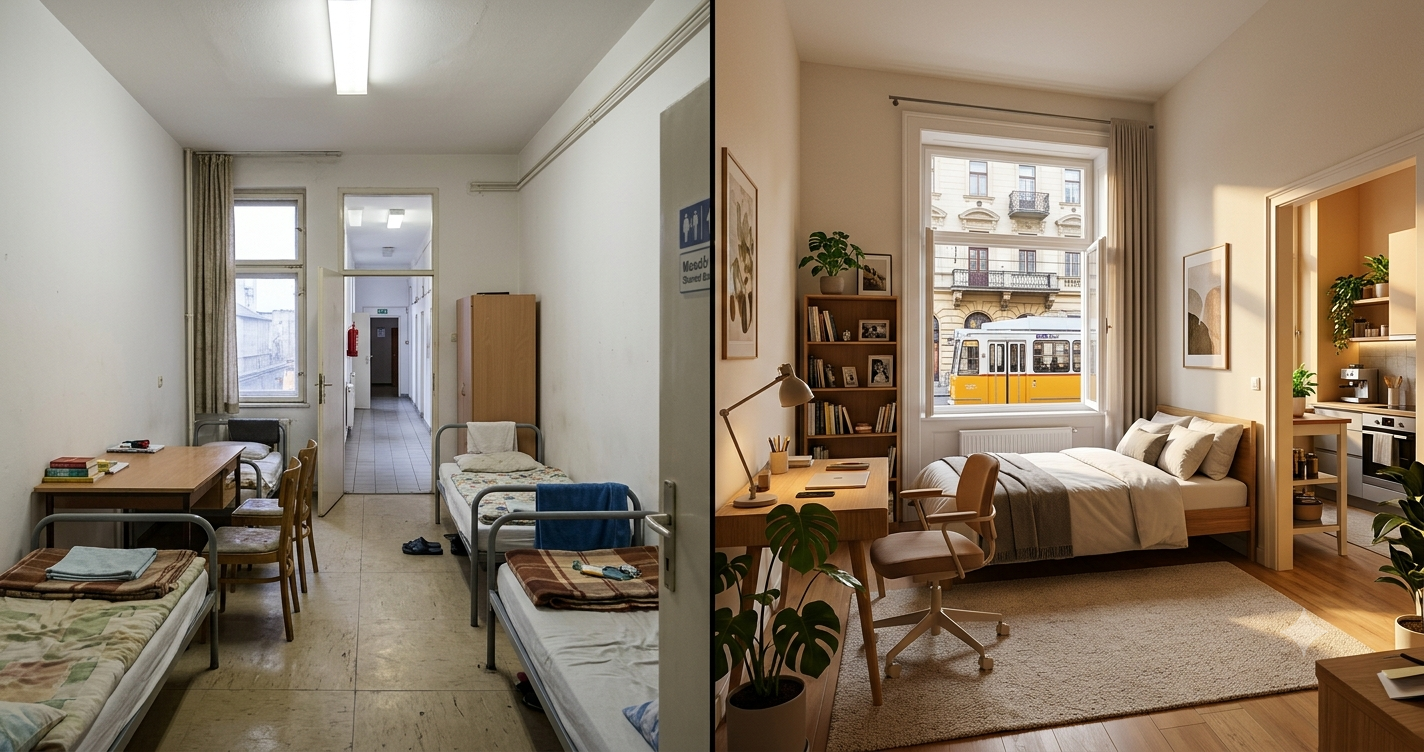
Central and Eastern Europe is the smart choice for student housing in 2026 because living costs are far lower than in the West: Eurostat's 2024 price levels put Poland and Hungary at about 72 to 74 percent of the EU average and Latvia, Lithuania and Czechia at 82 to 88, against 109 to 143 percent in Germany, France, the Netherlands and Denmark. Ten years ago, "study abroad in Europe" basically meant London, Paris, Amsterdam or Berlin. Today those cities are buckling under a housing crisis, rents have climbed past what most students can realistically pay, and student housing waiting lists are long. Meanwhile a quieter shift has been happening to the east. Riga, Budapest, Warsaw, Krakow, Prague, Vilnius and Tallinn, cities with serious universities, lively student scenes and rents that still leave room to actually enjoy the experience, have become where smart international students are heading. Affordable student housing in Eastern Europe is the single biggest reason why.
This guide makes the case for studying in Central and Eastern Europe, walks through the cities worth knowing, explains how the housing market really works, and shows why coliving has quietly become the most sensible way to live as an international student in this part of the continent.
The maths that started the migration east
Start with the numbers that drive everything else. A single person's monthly living costs, meaning rent, food, transport and going out, compare like this, using the monthly budgets that universities and official portals give international students.
- Western and Northern Europe (London, Amsterdam, Copenhagen, Zurich): €1,500 to €2,500 or more per month, with rent alone often €900 to €1,500 for a room
- Central and Eastern Europe (Warsaw, Budapest, Prague, Riga, Vilnius): €700 to €1,200 per month, with rent typically €300 to €600 for a room
- Public transport monthly pass: €20 to €40 in CEE cities, €70 to €100 in Western capitals
- Restaurant meal: €5 to €10 in Eastern Europe, €15 to €25 or more in Western Europe
For a student, that gap compounds fast. Over a five month semester, a gap of several hundred euros a month adds up to thousands. Same length, same workload, often a richer social life because you are not constantly counting coins. The case for the cheapest student housing in Europe isn't really about cheapness. It is about what the saved money lets you do. Weekend trips to Tallinn, Vienna, Budapest, the Tatras. Concerts. A gym membership. Eating out with classmates without flinching at the bill.
The quality myth, and why it doesn't hold up
The instinctive worry, especially from parents footing the bill, is that cheaper means worse. It is worth taking apart directly, because the data doesn't back it up.
Charles University in Prague was founded in 1348 and is one of the oldest universities in the world. Jagiellonian University in Krakow predates Columbus's voyage by more than a century. ELTE, Corvinus and Semmelweis in Budapest are internationally respected, with Semmelweis ranked among the top medical schools in Central Europe. The University of Latvia, Riga Stradiņš, Vilnius University, the University of Warsaw and the Warsaw School of Economics are institutions with real academic weight, not consolation prizes.
The bigger shift has been the growth of English taught programmes. As of June 2024, 43% of on campus English taught programmes outside the four big English speaking destinations (the US, the UK, Canada and Australia) were in Europe, and on campus English taught programmes worldwide grew by 22% between 2021 and 2024. You can now do an entire bachelor's or master's in English in fields from medicine and engineering to international business and computer science, often at tuition fees well below those of private universities in Western Europe; check each programme's fee on the university's own site.
You are not trading down. You are just paying realistic prices.
The best cities to study in Eastern Europe: a quick tour
There is no single best CEE city. There is the one that fits the life you want to have. Here is how the main contenders compare.
Budapest, Hungary
Budapest is arguably the most internationally established student city in the region. Expect a big international crowd (Hungary had about 49,000 international students in 2025), a famously good nightlife scene built around the city's ruin bars, thermal baths worth saving up for (a weekday day ticket at Széchenyi is 13,200 forints, about €36), and a public transport system that simply works. Universities like Semmelweis (medicine), Corvinus (business and economics), ELTE (humanities and sciences) and BME (engineering) draw students from across Europe and Asia. Corvinus University puts a dorm place at €100 to €200 a month and a rented flat at €250 to €750. A strong all rounder.
Krakow, Poland
Krakow is what happens when you combine a UNESCO listed medieval city, about 140,000 students and prices well below Berlin's. Jagiellonian University is the academic anchor and AGH University of Science and Technology brings the engineering crowd. The Kazimierz district has become one of the most interesting nightlife and café scenes in Central Europe. Rents typically run €280 to €450 for a room, and Erasmus students are particularly well served by a developed network of student focused housing.
Warsaw, Poland
Warsaw is the bigger, more cosmopolitan Polish option. Poland's economic and political capital, with the University of Warsaw and the Warsaw School of Economics (SGH) at the top of the academic pile. It feels more like a real European capital than Krakow does, which appeals to students who want the urban energy of a Berlin or Vienna without the price tag. Poland has about 1.3 million students (2025/26), but public dorms have beds for only about 9% of them and private student halls for about 1%, which means private rentals and coliving fill the gap. Rooms in Warsaw run €350 to €550.
Prague, Czech Republic
Prague is the most aesthetically perfect city on this list. Old Town, Charles Bridge, the castle. That is both its biggest draw and its biggest catch, because it is also one of the tightest student housing markets in the region. A 2025 Cushman & Wakefield report counted 2.9 students for every student bed in Prague, most of those beds in public university dorms. The upshot is that booking early matters more here than anywhere else. Charles University is the heavyweight and CVUT (Czech Technical University) anchors the engineering side. Expect €300 to €500 for a private room in a shared flat.
Riga, Latvia
Riga is the dark horse. Smaller than Budapest or Warsaw, less internationally famous, but punching above its weight. The University of Latvia, Riga Technical University, Riga Stradiņš (popular with international medical students) and Stockholm School of Economics Riga form a tight academic cluster, mostly walkable from each other. Art Nouveau architecture, a beach at Jūrmala 30 minutes away, and housing costs far below the EU average (Eurostat puts Latvia's 2024 housing price level at 55, against 100). Fuse rooms in Riga start at €250 a month, all inclusive. The student transport pass costs €12 per month. For a closer look at where to live, see our guide to the best areas to live in Riga as a student.
Vilnius, Lithuania
Vilnius is Riga's southern sibling. A similar pitch (Baltic capital, low prices, manageable size, growing tech scene) with its own flavour: a beautiful baroque old town, a famous bohemian quarter (Užupis) that declared itself an independent republic, and Vilnius University as one of the oldest in Northern Europe. Rents €300 to €450 for a room. Increasingly popular with Erasmus students who want a less obvious choice than Budapest or Prague.
Tallinn, Estonia
Tallinn is the smallest of the Baltic capitals and probably the most digitally advanced city you will ever live in. Estonia pioneered e governance and the whole city runs on it. Tallinn University and Tallinn University of Technology (TalTech) are well regarded, especially for tech and digital fields. The international student scene is smaller than Riga's or Vilnius's but growing fast. Rents €350 to €500. Best for students who want a quieter, more focused semester with easy access to Helsinki, a two hour ferry away.
The housing market reality, and why old advice doesn't work anymore
Here is the part most study abroad guides skip. The traditional CEE housing route, meaning find a Facebook group, message strangers in a language you don't speak, hope the photos match reality, wire a deposit to a stranger's account and sign a Latvian or Hungarian or Polish lease, used to be the only option. It still exists, and it is also where most of the horror stories come from. Scams targeting international students are common. Deposit disputes are routine. Heating bills can land in February with numbers nobody warned you about.
Only a minority of students in the region live in student accommodation: 9 percent in Poland, 12 percent in Latvia and 18 percent in Hungary, according to the EUROSTUDENT 8 survey. Everyone else rents privately, so it pays to know the pitfalls. Even when a private listing is genuine, check three things before you sign: whether bills are included (heating in a Budapest or Riga winter is not small), whether the landlord will accept a single semester when many want a full year, and what furnished means, since it can be anything from a full flat to a bed frame and a fridge.
The shift over the last few years has been the arrival of purpose built student accommodation and coliving in CEE cities. The big Western brands have started moving east. Local operators and a growing wave of newer players have built modern, all-inclusive housing aimed specifically at international students and young professionals.
The model is straightforward. One monthly price covers rent, utilities and internet in a furnished room, and some buildings add shared extras such as a laundry room or a study area. The lease is usually in English, often alongside the local language. You can usually book online before you even arrive in the country. The deposit is structured and refundable. And crucially, you land in a building where other international students already live, which means you skip the first month of knowing nobody that defines so many Erasmus semesters.
Why coliving has become the default smart choice
Five years ago, coliving was a slightly hipster optional extra in CEE student housing. Today, for international students arriving in a new country, it is increasingly the obvious choice, for a few concrete reasons.
- You actually know your monthly cost. All-inclusive pricing means no winter heating shock, no surprise bill increase, no fight over the internet contract. The price you sign for is the price you pay each month; just check whether the contract has a fair use cap on utilities.
- The lease is in English. Negotiating a Polish or Hungarian rental contract as a foreign student is a real barrier, and one most students badly underestimate. Coliving operators usually offer contracts in English: Fuse contracts are in English and Hungarian in Budapest, and English and Latvian in Riga.
- Community is built in. This is the part that is hard to put on a spreadsheet but easy to feel once you are there. Coliving spaces tend to host events, have shared kitchens and lounges, and bring together people who chose the same kind of housing for the same kind of reasons. Loneliness is a real problem for international students, and coliving solves a lot of it structurally.
- You can book before you arrive. Trying to find a flat from your home country, in a language you don't speak, before you can view anything in person, is one of the most stressful parts of moving abroad. Coliving turns it into a website transaction.
- It scales with how students actually live. Want a private studio for focus? Available. Want a shared flat with three other internationals for the social life? Available. Want to change cities mid year? Ask before you sign, because fixed term contracts usually run to their end date.
This is the quiet structural change that makes affordable student housing in Eastern Europe genuinely accessible now in a way it wasn't a decade ago.
What all inclusive student accommodation should cover
The term gets used loosely online, so pin it down before you book. In properly all inclusive housing, one monthly payment covers:
- Rent for a furnished room, with a bed, desk and wardrobe
- Electricity, heating and water
- Fast Wi Fi
- Repairs when something breaks that you did not cause
Ask whether there is a fair use cap on utilities. At Fuse, Riga homes have none; in Budapest, if the utilities of your room or flat go above €70 in a month, the extra can be charged. Cleaning of shared areas is usually down to the residents, so check that too.
Day to day student life in Central Europe
Once you are settled, everyday costs are where the region really lands. A monthly student transport pass is 3,450 forints in Budapest and €12 in Riga, and eating out is cheap by EU standards: Eurostat's 2024 price level for restaurants and hotels is 72 in Hungary, against an EU average of 100.
Seasons are real. Budapest in January is beautiful and cold, and in Riga the sun sets at about 3:45pm in mid December, so pack proper winter clothes. Summers are long and warm and spent outside, and social life forms fast, partly because shared housing is so common that you are rarely starting from scratch.
Checklist: sort this before you fly
- Confirm your housing before you travel, not after you land: a hostel booked for a week has a way of turning into a month.
- Get in writing exactly what the rent includes: heating, electricity, water, Wi Fi and any fair use limit.
- Check that the contract length matches your programme, and what happens if you need to leave early.
- Have scans of your documents ready: passport or ID, your acceptance or enrolment letter, and insurance. Fuse, for example, asks for an ID and proof of your reason for staying.
- Join your university's incoming student group chats early: that is where the real information lives.
A few practical things worth knowing
If you are seriously weighing up CEE for your studies, a handful of practical notes.
- Book early. Riga and Vilnius are still relatively open markets, but Prague, Budapest and Warsaw tighten significantly from late June. Start looking in April for a September arrival.
- Check what's included. Heating in CEE winters is not optional and can add a large sum to winter bills if it is billed separately. All inclusive pricing removes most of that risk; check for any fair use cap.
- Don't pay deposits to personal bank accounts. Pay only to a verified company with a written contract that states the deposit and when it comes back. Fake listings that ask for a deposit up front are a common student housing scam.
- Erasmus grants stretch much further here. Coming from a higher cost country such as Germany, France or the Netherlands, you get the lower Erasmus+ range, €225 to €550 a month set by your National Agency, and in CEE cities that covers a large share of your rent.
- Travel is part of the appeal. CEE is brilliantly placed for weekend trips. Riga to Tallinn (4 hours by bus), Krakow to Prague (about 7 hours by train), Budapest to Vienna (about 2 hours 40 minutes). Factor cheap regional travel into your overall budget, because it is part of what makes student life in Central Europe so good.
The bottom line
Studying in Eastern Europe used to feel like a budget compromise. In 2026 it looks more like the actual smart move. The universities are real. The English taught programmes have multiplied. The cities are vibrant, walkable and increasingly well connected internationally. And the housing problem that has broken student life in Amsterdam, Dublin, Munich and Barcelona simply hasn't reached the same scale here, especially now that purpose built coliving has made arriving in a new country something you sort from your laptop instead of in a panic on Facebook Marketplace.
If you are choosing where to spend a semester, a year or your whole degree, the question worth asking isn't whether the West has more name recognition. It is whether the East offers a better version of the student experience you actually want. For more students every year, the answer is yes.
Fuse has furnished, all inclusive rooms in Budapest and Riga, from €380 a month in Budapest and €250 in Riga on a 12 month contract, booked online with no viewing needed. Prague, Kraków and Warsaw are coming soon, with a waiting list on each city page.
Frequently Asked Questions
Sources
Every figure in this article comes from these pages, checked on October 11, 2026.
- Eurostat: price level indices 2024 (EU27 = 100), household final consumption E011 and housing A0104, dataset prc_ppp_ind
- ECB euro reference rates, 9 October 2026 (EUR 1 = HUF 365.08, PLN 4.3835, CZK 24.369)
- University of Copenhagen: living in Copenhagen estimated at EUR 1,280 to 1,800 a month
- Amsterdam University of Applied Sciences: cost of living (EUR 1,200 to 1,800 a month)
- King's College London: living expenses 2026/27 (average £1,770 a month)
- Vilnius University fact sheet 2025/2026: approx. 500 EUR a month, accommodation included (hosted by partner NOVA IMS)
- Corvinus University of Budapest: dorm EUR 100 to 200, flat EUR 250 to 750, total EUR 500 to 1,100 a month
- Study in Czechia (official portal): living costs (500 to 800 EUR a month, more in Prague)
- WSB University: living costs in Kraków (2,500 to 3,500 PLN a month, 2025/2026)
- PID Prague: 2026 prices, Prague passes unchanged (student 30 day pass 130 Kč)
- BKK: ticket and pass prices (monthly Budapest pass for students 3,450 Ft)
- Rīgas satiksme: one month ticket (EUR 30 full price, EUR 12 students)
- Széchenyi Thermal Bath: 2026 prices (weekday day ticket 13,200 Ft)
- Erasmus+ Programme Guide: student grant ranges (lower range EUR 225 to 550 a month) and country groups
- Studyportals and British Council: 43% of on campus English taught programmes outside the Big Four are in Europe (June 2024)
- ICEF Monitor: on campus English taught programmes rose 22% between 2021 and 2024
- Tempus Public Foundation: 49,458 international students in Hungary (2025)
- Statistical Office in Kraków: 141,436 students in the city of Kraków, 2025/2026
- Statistics Poland (GUS): 1,322.8 thousand students, 2025/2026
- Cushman & Wakefield: PBSA market in Poland 2026 (public dorms about 9% of students, private halls about 1%)
- Cushman & Wakefield: student housing in Czechia 2025 (2.9 students per bed in Prague)
- EUROSTUDENT 8 synopsis: share of students in student accommodation (Poland 9%, Latvia 12%, Hungary 18%)
- Sunrise Sunset API: Riga sunset 15:44 on 15 December 2026
- Jagiellonian University: founded 12 May 1364
- Seat61: trains from Kraków (Prague 6h48)
- Seat61: trains from Budapest (Vienna 2h40)