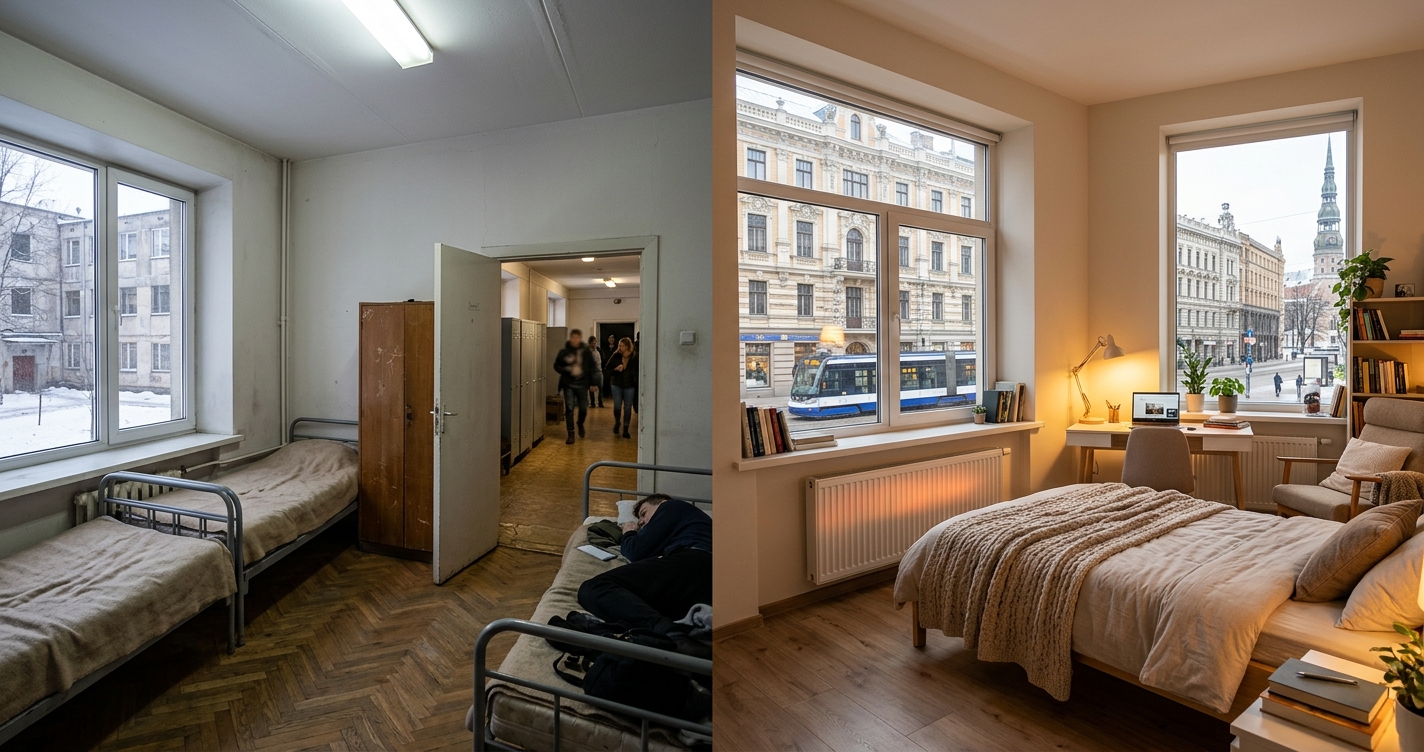
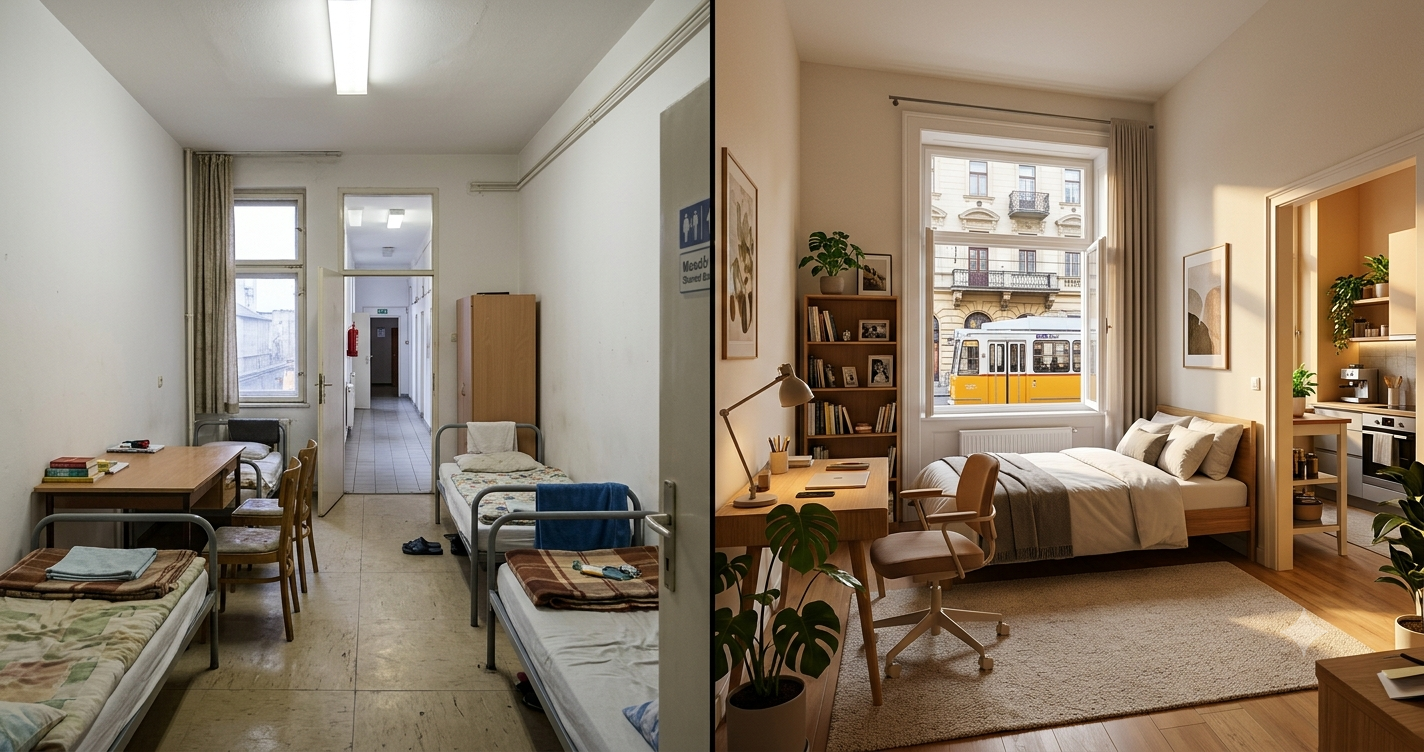
Flatshare, Coliving or Private Apartment: Which Fuse Room Fits You?
Fuse offers three ways to live: flatshare, coliving or a private apartment, plus shared rooms in some flats. How they actually differ and which one fits your semester.

When you browse Fuse listings, you'll notice three different room types: flatshare, coliving and private apartment. All three come fully furnished, all three include utilities and WiFi, and all three are available across Fuse's contract lengths of 5, 6, 10 or 12 months. So what's actually different, and how do you know which one is right for you?
The short answer: pick a flatshare if you want your own room in a normal flat with a few housemates, coliving if you're arriving alone and want the most built-in social life, and a private apartment if you want your own kitchen and bathroom and full independence. On a tight budget, a shared room in a flatshare is the cheapest way to live with Fuse.
This guide goes through each option honestly so you can make the decision once and not second-guess it after you've arrived.
What All Three Have in Common
Before the differences, the things that don't change regardless of which room type you pick.
Every Fuse room is fully furnished. You arrive with everything already there: bed, mattress, bed linen, pillow and duvet, a desk and chair, and a wardrobe or storage. Bring your own towels. You don't need to buy anything or spend your first week in an unfurnished room sleeping on the floor.
Every Fuse contract includes utilities (electricity, heating, water) and WiFi in the monthly price. One number, with one limit in Budapest: if the utilities of your room or flat go above €70 in a month, the extra can be charged. Riga has no fair use limit. This matters more than it sounds, especially in Budapest and Riga where winter heating costs in private rentals can catch students off guard.
Every Fuse booking runs on a fixed-term contract of 5, 6, 10 or 12 months with rent paid monthly. The difference between contract lengths is mainly cost and commitment, not the room type itself.
And every Fuse room goes through an application process. It isn't an extensive qualification process: you upload your ID and a document that shows why you're moving, such as an enrolment letter, internship agreement or job offer. But it does mean everyone you live with is there for studies, an internship, an early career role, volunteering or an exchange.
The Three Room Types
Flatshare
A flatshare at Fuse puts you in a flat of 4 to 7 people, and the room page shows how many housemates share it. You have your own private bedroom or, to save the most, a shared room with one housemate. You share a kitchen and sometimes a living room. That's roughly the arrangement.
The social level sits in the middle: more contact than a private apartment, less structured community than coliving. You'll see your housemates in the kitchen, you'll probably share a few meals over the course of the semester, and you'll build a group chat that gets used sometimes. Whether it becomes a proper friend group depends on the people, and a bit on you.
Flatshares tend to suit students who want a social element without making community the primary thing they're optimising for. If you already have people you're going to be spending most of your time with (friends from your home university on Erasmus together, for example), a flatshare gives you a decent home base without pushing you into a larger social structure you don't need.
The smaller group size also means less organised noise. Co-living spaces with 12 people tend to have a different energy to a flat with 5. If you're somewhere in the middle on how much social contact you want, flatshare is usually the natural answer.
Coliving
Coliving puts you in a larger setup: 7 to 15 housemates, your own private bedroom and sometimes a private bathroom, with a wider range of shared spaces beyond just the kitchen. Depending on the building, that means a lounge, a gym, a games room, a laundry or some combination of them. At Gát utca 19 in Budapest, for example, residents share an inner garden, a lounge, a shared diner, a games room and a study area, with a laundry room in the building.
The key distinction is that community is designed in, not left to chance. The shared spaces put you in the same rooms as your neighbours every day, and Fuse runs resident events in your city all year round. Students arriving alone in a new city don't have to do the work of constructing a social life from nothing. The environment does a lot of that work for them.
This is the option that suits students who are nervous about not knowing anyone. The nature of a coliving space means you're sharing a kitchen with people who are also arriving new, also figuring out the city, and also open to meeting people. The first two weeks are genuinely easier here than they are in a private flat where you might not cross paths with your flatmates for days.
The trade-off is straightforward: less privacy in the common areas, more people sharing the kitchen, a higher noise floor on a Friday night. None of this is a problem if you know what you're signing up for. It becomes one if you wanted something quieter and chose coliving anyway hoping it wouldn't be that social.
Coliving makes the most sense for students who are arriving alone and want a built-in community from day one. For a semester abroad where you're only there for 5 or 6 months, the faster pace of social connection it enables is a genuine advantage.
Private Apartment
A private apartment at Fuse gives you a fully private living space, just you (or you and one other person, depending on the unit). Minimal or no shared areas. Full independence.
This is the right choice if you want complete control over your space and schedule. No communal kitchen dynamics, no shared lounge noise, no housemates at all unless you're the one bringing someone. You cook when you want, in your own space, and you're not navigating anyone else's rhythms.
It's also the option that takes the most deliberate effort to build a social life around, because nothing about the housing situation creates it for you. That's fine if you have a social network coming into the city, if you're doing a full degree and have time to build connections more slowly, or if you genuinely prefer your own company most of the time. It's less fine if you arrive knowing nobody and discover three weeks in that you've barely spoken to anyone outside of university.
Private apartments at Fuse still come with all the same infrastructure as the other room types: fully furnished, all-inclusive pricing, a support team you reach on WhatsApp or by email, with a reply to emails within 1 business day, rather than a landlord you have to chase. The difference is just that your living situation is entirely your own.
How to Actually Decide
Three questions that tend to clarify it quickly.
How much does meeting people matter to you in the first few weeks? If it matters a lot, coliving. If you're indifferent or already have people lined up, flatshare or private apartment.
How long are you staying? Students on a 5 or 6 month semester tend to value the faster social integration of coliving more than students on a 10 or 12 month contract who have time to build connections more gradually. The shorter the stay, the more the built-in community is worth it.
How much shared-space noise can you live with? If you recharge alone and find communal living draining, the private apartment is probably right regardless of everything else. Coliving requires a genuine tolerance for shared space. Most people who are fine with it know it within a week; most people who aren't also know it within a week, which is too late.
One Thing Worth Knowing Before You Book
Choosing the right room type is half the decision. The other half is making sure the contract length matches how long you're actually staying. Fuse offers 5, 6, 10 and 12 month options across all three room types. Pick the one that matches your programme dates rather than the one with the lowest monthly figure, since paying for months you're not there is never the right move.
You can browse current availability by living style in Budapest and Riga (not every style is offered in every city) at fusestays.com/listings.